Total Pageviews

Tuesday, May 31, 2022

Live in Peace (2 Corinthians 13:11)


A group of Chapel Hill clergy met in the prayer garden at University Baptist one week after the massacre at Robb Elementary School in Uvalde, Texas. We began our prayer service at exactly 11:33, the time the horror began. Leaders from different churches and faith traditions were invited to have roles in the prayer service. I was assigned the benediction.

            I read the final verses of 2 Corinthians. It says, “Put things in order, … agree with one another, live in peace.” Then in the next verse Paul tells the Corinthians to “Greet one another with a holy kiss” (13:12). COVID 19 has greatly deterred this practice. I wonder what the world would look like if Christ followers were as concerned about greeting one another with love and affection as they are about getting their point across in arguments.

            While we aren’t kissing each other right now, we can strive for agreement, or at least mutual respect. COVID or no COVID, we can commit to working for peace. As tragic as what happened in Uvalde is, it has not brought people together. Advocates for restrictions on gun ownership are in a full fury, and gun-rights proponents are not giving an inch. Everyone is doubling down, staking their position. Compassion is not breaking through.

            It won’t. Tragedy does not make us more loving, more Christlike. The world is fallen. The loudest voices insisting that the proliferation of guns is what causes gun violence cannot help themselves from speaking in tired, politicized imperatives that leave no room for those who disagree with them. Those who love their guns are tone-deaf to the cries of the departed. Tragedy increases our animosity and gives our sinful nature an avenue of expression.

            In Christ though, we aren’t under sin. In Christ, seeking agreement and promoting peace and giving out buckets of compassion are all more important to us than winning an argument. We Christians should participate in the national conversation, but when we do, we need to remember who we are. We are His possession. The Holy Spirit speaks through us. So, we seek peace. We see Christ in the red-faced anger of those shouting their positions whatever their stand might be. We strive to love in Jesus’ name, and COVID be darned, we give the kiss of peace.


Tuesday, May 3, 2022

Where I want to be Wrong


            This really happened. I was 25. I was a seminary student eager to learn as much as I could, and then go pastor a church. I was in church history class and the professor was detailing all the schisms Baptists have endured over the centuries. This was 1995. At that time, in America, there were over 30 different Baptist groups.  Given our propensity to split over the smallest thing and given that 27 years have passed, I wonder how many distinct Baptist groups there are now.

            Our tendency to split over trivial matters. Our professor told us about a group of backwoods Baptists who were committed to simplicity in their expression of faith; this meant no adornments, no instrumentation with the hymns, and no artwork in the small clapboard church buildings. Then that church called a pastor who, out of necessity, nailed a peg in one of the walls. He needed a place to hang his coat. This was seen as an adornment and half the people left the church and started a new one. The other half loved the pastor enough to allow this extravagance, and they stayed. Those who started a new church came to be known as the “No-Peg” Baptists. Writing this, I wonder if our church history professor was bored one day and told the story just to see how gullible we were. There were no questions about the “No-Peg” Baptists on the final exam.

            Churches have split over whether the members should dance or not. In my most recent sermon, I mentioned occasionally having a beer with congregation members. Churches have split over alcohol consumption. And the place of divorced persons. None of these issues, dancing, drinking, or peg-hanging are found anywhere in the New Testament as marks of faith or indicators of the lack of faith. Yet, churches split over these and other second (or third or fourth) level matters.

            I always thought that if we were united on our need for God’s grace and our faith in the crucified, resurrected Lord Jesus, we could withstand all other divisions. United in the declaration that “Jesus is Lord,” other matters fade to lesser importance. I have been wrong! I have seen Christians who agree in their faith in Christ divide over lesser matters.

I am not above this. It would be hard for me to participate in a church that limited the leadership opportunities for women. I would absolutely not be in a church that practiced any kind of racism regardless of what they claimed about Jesus. I don’t believe someone can truly s submit to the Lordship of Christ and at the same be a racist.

Even so, I continue to hold onto the unity we have in Christ. I continue to insist if we meet one another at the cross and at the empty tomb, we can overcome any difference. Maybe our politics stay antagonistic; maybe our stances on certain issues continue to be at odds; maybe our tolerance for difference is sorely tested; regardless, I believe the unity in the crucified, resurrected Lord Jesus is more important that division over lesser matters. I have been wrong about this before and will gladly be wrong again if it means I come down on the side of believing in the unity Jesus gives. Jesus Christ crucified-resurrected matters more than any stance on any issue. There’s nothing bigger than this truth.


Tuesday, April 5, 2022

Holy Saturday


Faith from the Silence

4-5-2022


Where was Jesus, on Saturday? In the Apostles creed worshipers recite, in the fifth line, “He descended into Hell.” But did he? We Baptists don’t generally recite traditional creeds of the church. We don’t feel bound by them. ‘Descending into Hell,’ seems to say Hell is a place that is reached by descent (stairs, a downward climb or something else?). That understanding of a three-tiered universe, which requires a flat earth, by the way, is incompatible with our present day understanding of space-time.

First Peter 3:19, which tells us that Christ was put to death but then preached to “spirits in prison,” evokes images of Christ’s Saturday work without locking the story into a first century worldview. If prison = souls cut off from God because of sin and Christ, as 1 Peter says, preaches as a spirit, then this passage can account for his activity. Still, it is not a concrete, specific explanation.

Holy Week is a big deal. Palm Sunday, Maundy Thursday, Good Friday, and Easter Sunday each have special names. Monday through Wednesday seem appropriately pregnant with anticipation. But Saturday is just silent. I think that’s where we live our faith lives, on Silent Saturday.

We live after the crucifixion, the ascension, and Pentecost, but before the second coming of Christ. We live in that in-between time, and it’s a long time: two thousand years and counting. The silence of it, the waiting, the want for tangible, measurable certainty can be the soil in which our faith grows. We have to take on faith that the stories of the Bible happened and that the promises of scripture can be trusted. We have to believe that the Holy Spirit is active in the world and in us.

The Spirit cannot be weighed, fingerprinted, or tested for DNA. God acts in our world, but exists beyond it. God transcends our experience of reality. As we sing the anticipation of Palm Sunday, walk in the heavy sorry of Maundy Thursday and Good Friday, and rejoice in the piercing, life-giving light of Easter, we do well to pause on Saturday. We sit still. We listen. God may speak. God may not. Either way, because of faith, we live the only possible reality we know: God is with us, loves us, and will guide and bless our lives. We bank our very existence on the faith we have, a faith that spend most of its time growing on Silent Saturday.

Tuesday, March 1, 2022

Space for People in Pain


            Read John 4:1-42. No, don’t keep reading this. Come back to this, after, you’ve opened your Bible and read John 4. Thank you for doing that. The Samaritan woman is alone, apart from the community of women doing daily chores together. She lives with a man who wouldn’t even honor her with marriage. Five others have divorced or widowed her. The Samaritan woman lives with deep hurt, real pain. First century society collectively agreed to cast out women in her situation, through no fault of their own.

            In John, it is to her, not the disciples nor the temple or synagogue leaders, but to this Samaritan woman that Jesus announces his identity: the Messiah (4:26). In Mark’s gospel, Jesus is secretive about who he really is (1:34; 3:12). Scholars refer to his tendence, in Mark, to avoid disclosures of his true identity as the “Messianic secret.” That’s in Mark. In John, Jesus announces to a “rejected woman” the Messiahship he keeps secret in Mark.

            She is not rejected by Jesus. But she does know pain. Do you? Are there people in your life who know the kind of pain the Samaritan woman carried, the pain of a damaged reputation, of being reduced in society’s eyes, of being an outcast? Do you know someone in that kind of pain?

            Make space for that person because he or she needs Jesus as much as the Samaritan woman did. The church is the body of Christ in the world today. The church needs to show hurting people what the love of Christ can do for their lives.

            Lent is upon us. Easter is seven weeks away. (1) Make space for someone’s pain in your life. (2) Extend to them the same dignity and grace Jesus gave the Samaritan woman. (3) Commit to prayer for 40 days; in this time prayer lift up that person you know who is hurting so badly. Also, bring your own pain to Jesus and receive the healing he gives.


Wednesday, February 2, 2022

Justification and Other Core Ideas

Christian Concepts to Remember (2-2-2022)

             In the sermon at Hillside on Sunday, February 6, I will speak about Justification by Faith. Alister McGrath calls this “the central theme of both the Old and New Testaments”.[i] Do you agree? Or, would you say salvation is the central theme? Or, redemption? Or, New Creation? McGrath would locate all these important ideas along with restoration, regeneration, forgiveness of sins, and many others under the category of justification.

            I do not think the average churchgoer who doesn’t regularly read theology books will be able to differentiate between these terms. I regularly read theological works and tomes, and it’s not easy for me to distill the ideas into concise definitions. Theological thinking is beneficial, and I will, in the preaching, attempt to help the church grow in theological understanding.

            Here, though, I invite you to focus on just two concepts. First, you and I absolutely need God. Whatever justification is, and there are countless books on justification, most every theologian and Bible scholar agree it is instituted and initiated by God. Human beings are sinners cut off from God and we cannot get to Him on our own effort. In Jesus, God comes to us, removes our sin and invites us to receive forgiveness. He invites us to live as His children.

            The second idea is relationship. I am sure a lot of people hear pastors like me talk about relationship with God, and they think, ‘I can’t see or hear God. How can I have a relationship with one I cannot see or hear?’ I get it. This question makes sense. Relationship with God can only be had if we acknowledge there is more to reality than what we can see, hear, taste, smell, or feel.

            God may, on rare occasions, speak in an audible voice, but God is always speaking to our spirits. The relationship God desires with us is one of love, one in which our integrity and autonomy are respected, and one in which we will grow. If you come to God in your need, and if you tune out the distractions of social media, toxic relationships, unhealthy amounts of screen time, and whatever contributes to societal ADHD, you will find that a relationship with God can be had. The relationship will grow and deepen the more you give yourself fully to it. And, the longer you are in this relationship the more joy and richness of spirit you will discover.

            Need for God; relationship with God; proceed in your faith under these ideas. From here, the theological concepts, the preaching, and other modes of experiencing discipleship will enhance your walk with the Lord.


[i] Alister E. McGrath (1988), Justification by Faith, Academie Books: Zondervan Publishing House (Grand Rapids, MI), p. 11.


Thursday, January 27, 2022

Pastor Rob Recommends ... (January 28, 2022)


Brothers Karamazov

By Fyodor Dostoevsky (1879; 1984 by Bantam Classics)


It’s worth the time to make the journey through Dostoevsky’s classic. He shows the gospel and many of the questions the gospel births in the minds of women and men.


Pastor Rob Recommends ... (January 27, 2022)

 Pastor Rob recommends …


Hospitable Planet: Faith, Action, and Climate Change

By Stephen Jerovics (2016)


In this book you will find a spiritual/scriptural foundation for recognizing creation care as a key aspect of discipleship. You will also find practical ways you can get started in creation care.


Wednesday, January 26, 2022

Pastor Rob recommends ... (January 26, 2022)

Pastor Rob recommends …


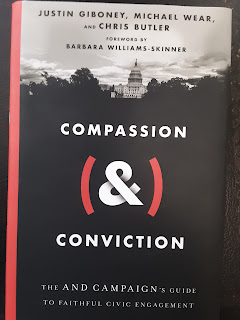
Compassion (&) Conviction: The AND Campaign’s Guide to Faithful Civic Engagement

By Justin Giboney, Michael Wear, and Chris Butler (2020)


The authors offer a brilliant argument for the way Christians in America can and should participate in politics and civic life.  Their political expression is an extension of their faith and is rooted in scripture.  Truly Christian political participation cannot be partisan.  It must be faith-based, and these authors makes this point beautifully and thoroughly.  Have your Bible ready when you read this book.   If you engage with the scriptures the way the authors do, you'll find their conclusions to be on solid ground, you'll be ready to follow their guidance by participating in public life yourself, and by doing it as a follower of Jesus.


Pastor Rob recommends ... (January 25, 2022)

Pastor Rob recommends …


The Allure of Gentleness: Defending the Faith in the Manner of Jesus

By Dallas Willard, edited by Becky Heatley (2015)


God bless Dallas Willard's daughter.  She brought together some of his last talks and edited them into book form.  It's a final word from one who was brilliant in teaching apologetics and evangelism by way of discipleship.


Pastor Rob Recommends ... (January 24, 2022)

Pastor Rob recommends …


A Testament of Hope: The Essential Writings and Speeches of Martin Luther King Jr.

Edited by James M. Washington (1986)


The subtitle tells you exactly what this book is. It also begs the question. Do you even know what Martin Luther King said and did? Everyone in America admires him. Many, especially many white people, express that appreciation in an unveiled attempt to appropriate his fame to promote themselves. Do we know MLK’s actual thoughts? This book is long, 679 pages. And you should read every word.


Sunday, January 23, 2022

Pastor Rob Recommends ... (January 21, 2022)

Pastor Rob recommends …


Letters from a Skeptic: A Son Wrestles with His Father’s Questions about Christianity

Dr. Gregory A. Boyd and Edward K. Boyd (2008)


Dr. Gregory Boyd shares a series of letters exchanged between himself, a Christian theologian living in Minnesota, and his retired father, a retired, unbeliever living in Florida. The letters extend over a period of a little over a year. The tone is irenic, but Greg the son is open and clear; he wants his father Ed to become a follower of Christ. The journey is beautiful to observe. Also, Gregory Boyd's outreach to his father challenges any Christ follower who reads the book to do what he has done and reach out to someone they love who is an unbeliever.


Pastor Rob Recommends ... (January 20, 2022)

Pastor Rob recommends …


The Flavor of our Faith: Reflections on Hispanic Life and Christian Faith

Karen Valentin (2005)


Valentin offers a beautiful, genuine picture of Christian faith from the perspective of a Latinx family living in the United States. Her moving portraits of how God has defined and blessed her identity as Puerto Rican woman who lives her life in Christ.


Wednesday, January 19, 2022

Pastor Rob Recommends ... (January 19, 2021)

Pastor Rob recommends …


The Poverty and Justice Bible (2008)


In the Poverty and Justice Bible, all the verses related to justice and God’s care for the poor are highlighted in orange. Reading this will impress upon the readers that if you want to be on the side of God, you have to advocate for justice and care for the poor, widow, and orphan.


Tuesday, January 18, 2022

Pastor Rob Recommends ... (January 18, 2022)

Church: What to Do When Everyone is Like You

Daynette Snead Perez (2021)


Daynette Snead Perez asks a question every church should ask itself.  “Can there be unity and diversity here?”  In her latest book ‘Church: What to do When Everyone is Like You,’ she answers ‘yes,’ and ‘yes.’ There can be unity in your church.  In fact, there must be.  And there can be diversity, no matter where your church is.


Snead Perez doesn’t just make the assertion.  She charts the course.  Blending Biblical principles, bible stories, and her own story, the author introduces the reader to her Stranger to Neighbor ministry.  This approach to unity/diversity is going to catch on and alter the way churches see the people who walk through their doors as well as the people in the community who walk past their doors.


Pick up a copy of this book for your pastor, you church elders and deacons, the Sunday school teachers, and yourself.  You’ll come away ready for a more colorful, blessed future for your church.


Monday, January 17, 2022

Pastor Rob Recommends ... (January 17, 2022)

 Pastor Rob recommends …


Mere Christianity

C.S. Lewis (1952)


Lewis writes, “Now the whole offer Christianity makes is this; that we can, if we let God have his way, come to share in the life of Christ.” The brilliant 20th century author/thinker unfolds the essence of a life spent following Jesus.


Saturday, January 15, 2022

Pastor Rob Recommends ... (January 14, 2022)

 Pastor Rob recommends …


The Way of the Wolf: the Gospel in New Images

Martin Bell (1970)


Bell’s creative use of imagery and metaphor in his poems and short stories frames the Christian faith in moving, beautiful, creative settings. This book was instrumental in my faith development in my college years.


Pastor Rob Recommends ... (January 13, 2022)

 Pastor Rob recommends …


The Way the World Is: The Christian Perspective of a Scientist

John Polkinghorne (2007)


Christians who want their witness to be taken seriously by 21st century listeners have to account for scientific discoveries in their testimony. Christ, not science, determines a Christian’s worldview. However, science is not to be ignored. The late John Polkinghorne, a physicist and Anglican priest brought these worldviews together in a way that encourages Christians to develop their faith in a world that listens to scientists.


Wednesday, January 12, 2022

Pastor Rob Recommends ... (January 12, 2022)

 Pastor Rob recommends …


That All Shall Be Saved: Heaven, Hell, & Universal Salvation

David Bentley Hart (2019)


Bently Hart makes a compelling case for taking a long look at passages like John 12:32. Jesus said, “When I am lifted up, I will draw all people to myself.” Hart shows how this and many other pericopes raise questions about traditional, widely held assumptions about Heaven and Hell. 


Pastor Rob Recommends ... (January 11, 2022)

Pastor Rob recommends …


Crossing the Lines we Draw: Faithful Responses to a Polarized America

Matthew Tennant (2020)


Drawing on his reading of scripture, his understanding of Christian theology, and his experiences as a pastor, Tennant presents a case for reconciliation. He urges Christ-followers to reach across racial and political divides to unite with their fellow human beings.


Monday, January 10, 2022

Pastor Rob Recommends ... (January 10, 2022)

Pastor Rob recommends …


Surprised by Hope: Rethinking Heave, the Resurrection, and the Mission of the Church

N.T. Wright (2008)


The subtitle says it all.  This is one of the most helpful books on the resurrection and on what happens when we die on the market today. It’s readable, biblically sound, and, as the title indicates, a word about hope.