Total Pageviews

Showing posts with label Jesus. Show all posts

Monday, January 10, 2022

Pastor Rob Recommends ... (January 10, 2022)

Pastor Rob recommends …


Surprised by Hope: Rethinking Heave, the Resurrection, and the Mission of the Church

N.T. Wright (2008)


The subtitle says it all.  This is one of the most helpful books on the resurrection and on what happens when we die on the market today. It’s readable, biblically sound, and, as the title indicates, a word about hope.


Monday, March 8, 2021

"The Gospel of the Cross" (1 Corinthians 1:18-2:5)


watch - https://www.youtube.com/watch?v=tCE6NC0IICs

3rd Sunday of Lent, March 7, 2021


            Theologians get frustrated by the idea of “the Gospel;” at least, they should!  People all over the world have their own ideas of what the Gospel is.  With so many different viewpoints, is it possible to define it at all?  And if it can’t be defined, does it mean anything?

            Theologians are stimulated by the idea of “the Gospel;” at least, they should be!  With the different ways cultures around the world have lived out the Gospel, the depth and breadth of the Gospel’s meaning and beauty of the gospel’s expression seems inexhaustible! 

            “Time out!”  You tell me.  “I’m not a theologian,” you say.  “Why should I worry about the dozen different gospel definitions that spill out of the pointless musings of one or two theologians?”

            I see your “time-out” and acknowledge it.  The work theologians do is important for Christianity, yet I agree that you don’t have to do a theologian’s job.  However, when we claim to be Christ-followers, we accept all the to share the Gospel. Jesus does not recognize followers who refuse to bear witness to him. We understand that Jesus is not interested in believers or admirers.  Jesus seeks out disciples.  In Mark 3:11, Jesus silences demons who express their belief in him.  In John 12:23, Jesus ignores the fan-boy Greeks looking for an autograph and instead insists that his concern is his followers (v.26), disciples.  To follow him, is to share the Gospel.  To share the Gospel, we have to have some idea of what it is.

            So, what is it?  Since the first century, Christian thinkers have debated this question.  In 1 Corinthians 1 & 2, the Apostle Paul provides a foundation.  If we stand on this foundation, we will be able to live within the Gospel, we will be empowered to share the Gospel, and we will find ourselves freed by the Gospel. 

            In his work A Theology of the New Testament, the late George Eldon Ladd writes, “The Gospel is the proclamation of the historical fact and the redemptive meaning of the cross, which includes both present and future blessings.”[i]  Note, the gospel is event and meaning.  That Jesus died on a Roman cross outside of Jerusalem is an event in history.  Few historians, Christian or not, question this.  A lot of unfortunate people died on crosses under Roman oppression.

            This historical fact matters.  We believe Jesus was innocent and was God’s son, and in his death took on himself the eternal penalty all people deserve because of their sins.  So, the Gospel says this is a historical happening filled with significance.  In fact, Christians hold that the death of Jesus on the cross and the subsequent resurrection is the most important event in history.  Because of this historical fact and what it means, we can develop the mindset of disciples.  

            Paul says in 1 Corinthians 2:2, “I decided to know nothing among you except Jesus Christ, and him crucified.”  In 1 Corinthians Paul teaches on more topics than in just about any other letter.  He addresses leadership within the church.  He condemns sexual sin while affirming sexual relations between a man and a woman in the confines of marriage.  He commends singleness and celibacy, but says if you must get married be sexually active; if you must be sexually active, get married.  He gives his most detailed instructions on how to celebrate the Lord’s supper, and on spiritual gifts in this letter.  He delivers his most developed teaching on the resurrection.  It’s all in 1 Corinthians.  After chapter 2, he doesn’t really address atonement – Jesus’ death on the cross for our sins.  So why does he make this sweeping remark: “I decided to know nothing among you except Jesus Christ, and him crucified?”  He deals with much more than that. 

            He can touch on so many topics because he’s standing on the solid ground, the foundation of the crucified Christ.  In chapter 1, verse 23, he makes a point of saying that for Jewish people the thought that Messiah would die so shamefully, on a Roman cross, is a stumbling block. The Greek word for stumbling block is skandolon.  A crucified Messiah was a scandal for the first century Jews who had rejected Christ.  For Greeks, who generally rejected any value in the body and instead esteemed spiritual ideals, the thought of following a man who died was foolish.  And, of course, the Romans saw those they crucified as weak. 

            In different ways, Jews, Greeks, and Romans, devalued the crucifixion of Jesus, but Paul says for everyone – Jews, Greeks, everyone – it is the power of God and the wisdom of God.  God did not magically make sin disappear.  Doing so would ignore the serious offense and awful consequence of sin. God does not force us to not sin.  This would strip us of our free will and we would no longer be God’s image-bearers.  God decided to love us so deeply, our sins would be paid for with the death of God’s beloved son, God-in-human-flesh, the sinless one, Jesus. 

            Paul says, in 1 Corinthians 1:21, salvation comes through the preaching of the cross to all who believe.  Note how many different actors God includes in the process of salvation.  First, there’s Jesus who willingly dies because he loves everyone.  Next, the Holy Spirit inspires disciples to believe in Jesus and follow him.  Third, there’s disciple who preaches the story and truth of Jesus.  It could be someone preaching to 1000’s in a large auditorium, or someone sharing the gospel with one other person.  Fourth, the listener receives the story, responds to the nudge of the Holy Spirit, and puts his or her faith in Christ.  Finally, the Father accepts that expression of faith and adopts that person as a son or daughter of God. 

            Just as Jesus’ death on the cross was a moment in history, so too comes a specific moment when an individual puts his or her faith in Christ.  Sometimes the new believer is baptized in that moment.  Other times, baptism comes later, as a visual expression new life.  We keep in mind that salvation is something that happens.  It is also a process that takes place over a lifetime. 

            Oxford theologian Paul Fiddes details the way salvation is a lifelong, continuous processg for a disciple in his book Past Event and Present Salvation: The Christian Idea of Atonement.  First, he explains that divine-human relationship can be repaired.[ii]  Our rebellion has severed our tie to God.  We need the connection re-established.  That repair happens in the death of Jesus on the cross. 

            Are things in your life broken?  Do you stare into a hopeless future convinced the broken things never get fixed?  The cross is all about repair.  The cross is a sign that the love of God moves us past our brokenness.  You can live life in a right relationship with God.  With the Holy Spirit in us, we can truly love each other. 

            Second, with the God-human break having been repaired, we come into human community in a new way.[iii]  Made new in Christ, we make up the church with others who have also been made new in Christ.  Thus, salvation effects not just the individual, but also the community.  “I am made new.” And, “we are made new.”

            Third, Fiddes observes that this repaired relationship and transformed community results from a complete upending of our understanding of God.  Fiddes writes, “If God has made a crucified man lord of the universe, then all the securities by which we live and all the achievements by which we justify ourselves and give ourselves esteem, are shown to be hollow.”[iv]

            What makes us feel safe?  The American army?  In other countries, our American power is a threat.  What makes us feel safe?  Our police force?  Many people in our communities feel their lives threatened by that very police force.  What makes us feel safe?  What achievements make us feel good about ourselves?  Our salvation rests on a Galilean peasant carpenter who was crucified, the most shameful of death.  God has declared that he, not some great warrior, king, or champion, but the crucified one is Lord and Savior. 

            Fourth, in Fiddes’ explanation, this salvation that upends our understanding of real power is, in addition to being an event, also an on-going reality.[v]  The Holy Spirit links our lives to what happened at Calvary 2000 years ago.  Through the daily transformation the Spirit effects in us, the love God shows on in the cross flows through us to the people we meet. 

            Paul could touch on so many topics in 1 Corinthians because he set his writing up on the foundation of the cross.  We stand on that same foundation, live our salvation, and share the good news with people who have not yet put their trust in Jesus.  We are freed by the Gospel.  Greed, racism, injustice, oppression, jealousy and so many other sinful ways of being that drive people apart do not bind us.  Freed from these godless obstacles, we are able to live in love and to give love. 

            Life will frustrate us.  That’s a given.  The Gospel, though, frees us.  Theologians can delight and struggle in the work of defining the Gospel and our faith is strengthened by their efforts.  For out part, we look to the cross and realize we are free.  We are free to live as children of God.

AMEN


[i] G. Ladd (1974), A Theology of the New Testament, William B. Eerdmans Publishing Company (Grand Rapids), p.385.

[ii] P. Fiddes (1989), Past Event and Present Salvation: The Christian Idea of Atonement, Westminster/John Knox Press (Louisville), p.4

[iii] Fiddes, p.13.

[iv] Fiddes, p.24.

[v] Fiddes, p.29-30


Tuesday, March 2, 2021

Out, into the World


Jesus tells his disciples, “you will be my witnesses in Jerusalem, in all Judea and Samaria, and to the end of the earth. … Go therefore, and make disciples of all nations” (Acts 1:8; Matthew 28:17).  Anyone who feels uncomfortable with the imperative on Christians to share their faith and lead others to follow Jesus needs to take that discomfort up with him.  The call to be witnesses and evangelists, comes from Jesus, so if we don’t like the idea of trying to influence others by introducing them to him, we need to take our dislike to him.  Don’t complain to the pastor that you think evangelism is spiritually arrogant or culturally imperialistic.  Take it up with the giver of the command, Jesus.

            I took our youth group for a walk on Franklin Street in Chapel Hill, Sunday afternoon, when the weather was so intoxicatingly pleasant.  With social-distancing easing up a bit and the weather so nice, everyone was out.  College students; town residents; the street was abuzz with life.  We were able to catch a glimpse of a bit of the world Jesus wants us to evangelize.

            Refuge (the Hillside young adult small group) has been following the series “In Pursuit of Jesus,” https://inpursuitofjesus.net/.  Pastor Rasool Berry travels the world looking for signs of the presence of Jesus, and he finds them in New York City, Singapore, Sweden, and other places.  Viewing these videos, we get more impressions of the world Jesus sends us to, in order to be his witnesses.  I highly recommend you check this out.

            Evangelism is not easy and can feel kind of icky if we conceive of it as trying to sell strangers something they don’t want to buy.  But, if we can learn to see the people we meet as neighbors, and if we can love them deeply, and if we can think of evangelism as sharing the most wonderful truth that all people need, then we can embrace the call.  To be Christian is to be called by Jesus.  Will we answer?

            Let one of your Lenten practices be prayer for evangelism.  Pray that people who don’t know the Lord will come to know him through the testimony of humble, loving Christ-followers.  Ask God to help you see how he wants you to share your testimony.  Ask Him to infuse your own witness with gentleness, hospitality, and grace.  And, spend significant time asking God to show you the Judea and Samaria to which he is sending you.  What will be your evangelistic field?  Then, listen to His answer.  Then, go.  Go out into the world, to share the good news of life in Christ.


Tuesday, February 9, 2021

"Return" (Zechariah 1:1-17)


watch - https://www.youtube.com/watch?v=wJMCSvMKLms&t=11s

Sunday, February 7, 2021


            Who are we? Who will we be?  Beloved movie heroes entertain us for 2-3 hours, trying to answer these questions.  Elsa in Frozen; who will she become, now that everyone knows she has super powers?  Luke Skywalker in Star Wars; will he ever become a Jedi Knight?  If he does, what then?  Steve Rogers in the Avengers; once the skinny weakling takes the super-soldier serum, what then?  What does he become? 

            As much as I love these stories, I find your more interesting because, (1) I can see you and talk to you.  You’re real!  And, (2) you don’t have super-soldier serum, you can’t shoot icicles out of your hands, and you can’t control force.  What you have going for you is the Holy Spirit!  I want to hear your story once the Holy Spirit enters your life.

            I want to find out who you are when you are ‘in Christ.’  I want to find out who the church will become.  The pandemic has rattled the church’s sense of itself.  Potlucks; bedside hospital visits; raucous laughter shared around the front hall coffee pot before the worship service; laying hands on someone being commissioned or ordained; embracing a friend; these things make the church and we can’t hardly do any of them.  Thanks, COVID-19. 

            What’s more, our church had just changed our name to “Hillside.” At the end of 2019.  We were coming out of two years of bumpy transition.  We were in the process of rediscovering our identity before COVID came along!  Does that mean we were ahead of every other church that had to deal with re-evaluating itself in light of COVID?  Or did it mean we were set back a year in the work we were doing to once again hear and answer God’s call.  I think it’s a little of both.

            More and more people are vaccinated each day.  The end is coming and when it does, we’ll have to be ready to understand our identity so we can be God’s witnesses here, drawing people in our town to Jesus.  But really, we have to begin that work before the pandemic ends.  Right now, today, we are called to be witnesses who tell what we have seen and experienced in following Jesus Christ.

            I had us begin 2021 in Haggai and now in Zechariah because these prophets spoke the word of the Lord to the covenant community in Jerusalem after the exile.  Exile had diminished them, displaced them, and broken them.  None of that changed the call.  Israel was to be God’s chosen people through whom the entire world would know and worship and serve the only true God. 

Exile had been the means by which God had punished his people for failing to answer that call and live his way.  When we get to Haggai and Zechariah, we find that the exile is over.  It’s time to start over, rebuild, and once again turn to the Lord and then draw the world to the Lord.  These prophets speak God’s word to a rebuilding people.

We are a rebuilding people.  The “who” question is an identity question.  Zechariah is not part of the answer to the “who” question.  Zechariah is a guide.  Listening to his truth, it sinks in.  We are the answer to the “who” question.  Who is this story about?  It’s about God as God is revealed in a rebuilding congregation, Hillside Church, emerging from years of transition and seemingly endless months of social distancing.  Who will we become as God’s people in Chapel Hill?

In this story, we are the “who”. God’s church.  What about the “what” and the “how”?

Who will Hillside Church be when we live into the identity God gives us?  “What” is the next question.  What needs to happen for us to be ready to live into our God-given identity as a people? The prophet Zechariah tells us in chapter 1.

“Return to me,” says the Lord of hosts in verse 3.  Zechariah warns the people not to repeat the mistakes of their parents, the exile generation.  God invited them to return, but they continued in their rebellion.  Now, they were gone. God’s word remained.  And so, the invitation is once again given.  “Return to me” (1:3).   

Zechariah writes in verse 6 that the people repented.  They turned away from injustice. They turned away from the worship of idols, false gods.  They turned away from sin and turned to God.  In their broken state, they accepted God’s justice, including the punishment.  With exile over, they were ready to return to God.

After this initial call to repentance and report that the people answered by repenting, Zechariah shares the first of his seven “night visions.”  At night, in a grove of myrtle trees, he sees a man astride a horse, and behind them several horses of different color, typical colors for horses. 

These horses act as God’s emissaries patrolling the earth.  The vision depicts for the prophet what he and we already know.  God can see the entire earth.  He is all-seeing and all-knowing.  The angel reports in Zechariah 1:11 that all is calm, the earth is at peace.

How can this be so?  How we say “all is well” when God’s temple is a pile of rubble and God’s people live as exiles?  Thus, the angel, not the prophet, confronts God asking accusingly, “How Long, O Lord” will you withhold mercy” (1:12)?  We can relate.  We know people refuse to wear masks, gather in close quarters, and ignore good pandemic behavior.  We know part of the reason this contagion has persisted and dogged us as it has is that people don’t do what is necessary to curb it.  Still, like Zechariah’s angel in chapter 1, we look to heaven, shake our fists, and through our tears bellow out, “How long will this go on, O Lord?” 

Zechariah 1:13 shows God as an understanding counselor, a patient therapist.  It says the “Lord replied with gracious and comforting words to the angel.”  In this same chapter, God is angry and God is understanding.  Both are true because God is perfect love. In verse 16, God says, “I have returned to Jerusalem with compassion.” 

Human suffering breaks God’s heart, even when we bring the suffering on ourselves.  God’s compassion is always for us.  As Jesus says in Luke 15, “There is joy in the presence of the angels of God over one sinner who repents” (15:10b).  God wants us to be free of the pain sin imposes and God offers us that freedom.  We need to turn to Him.  We turn from the sin, acknowledge our absolute need, and turn to God.

Thus the “who” – our identity is defined by the “what”; what we do.  We see understand that we can only live dependent on God.  We turn away from putting our faith in people, things, dreams, and systems.  We turn from that and we turn to God.  The “what” is our need for His grace, for the Spirit’s empowerment, for forgiveness, and energy to start again. 

What about the “how?”  Who?  What?  How?  How do we begin living into the identity God has given to us? 

This part of the story is God’s work.  God says, in Zechariah 1:16, “I have returned, with compassion.”  More than once in Haggai God says, I will be with you.  The Gospel of Matthew ends with Jesus’ promise to his disciples (and to us), “I am with you always to the end of the age” (28:20).  In Revelation, we know that at the end of the age, Jesus returns, we are resurrected, and we live forever with him in our resurrection bodies.  The presence of God ties this all together. 

Just as Zechariah prophesied the temple building in Jerusalem, 515BC, we will build Jesus’ church right here in Chapel Hill.  God is with us, so we can do it.  We can encourage each other, feed the hungry, share good news, love all who come, and grow our family because God is here, filling us with His empowering spirit. 

Furthermore, in Zechariah 1:17, God declares, “My cities shall again overflow with prosperity.”  We will flourish as God’s church because we stand in our need, as a broken people who have been healed by love, a dead people born again, a repentant people made new.  It’s the story of God and us – us returning to the God who loves us.  That repentance is our act of acknowledgement and faith.  And the story ends in joy and peace because God is present.

At the communion table, we take a necessary step in the story.  We come to the table as we are.  We don’t put on a false front, no facades.  We don’t hide behind masks of respectability, false presentations of our best selves.  We wear our warts, pimples, scars, wrinkles and dried tears.  This is us.  We come name what we have lost.  We hold out our mistakes.  We have in mind those we have hurt either by our actions or our failure to act. 

On our way to the communion table, a table welcoming all, we stop at the cross.  There we lay down everything – our entire story.  When Zechariah says “return,” this is the repentance we ought to have in mind.  All are welcome, but we can’t get to the table without a stop at the cross.  We meet Jesus at the cross, and he guides us to take our seat at the table where we gather with brothers and sisters, a family, united by God’s love. 

Take your place.  Bring your story.  Open your heart to God.  Receive the grace and forgiveness he gives.  And the prosperity.  He makes us new.  Even as wrong as things seem in the world, he makes things right.

AMEN


Monday, June 22, 2020

"This or That" (Matthew 16:19-24


How Can You Store Up Treasure in Heaven? - Pastor Rick's Daily Hope


Sunday, June 21, 2020


            “We are confronted by an either/or” in Christianity.[i]  If our lives are lived according to New Testament teaching, if we desire to walk in the way of Jesus, we must choose this, and reject that.  It’s clear and decisively obvious.

            Some teaching are not as black and white. In Mark 9:40, Jesus says, “Whoever is not against us is for us,” and in Matthew 12:30, “Whoever is not with me is against me.” Matthew 5:20, “Unless your righteousness exceeds that of the scribes and the Pharisees, you will never enter the kingdom of heaven.”  Yet in Luke 23, one of the criminals on one of the crosses next to Jesus admits he deserves his fate.  He is guilty.  Jesus promises him, whose righteousness certainly does not exceed the scribes’ that he will be with Jesus in paradise that very day (Luke 23:41, 43).  The Bible contains nuance and mystery. We spend our lives interpreting it.

            Matthew 6:19-24 is not one of those contradiction passages hard to understand.  Jesus’ words here are clear.  The difficulty of Matthew 6:19-24 is we have to deal with it. “Do not store up treasures on earth; … store up treasures in heaven. … Where your treasure is, there your heart will be also.”  “No one can serve two masters; for a slave will either hate the one and love the other, or be devoted to the one and despise the other.  You cannot serve God and wealth”.

            Jesus does not mean slaves have to love cruel overlords.  Every black slave during the first centuries of American history up to the Civil War was a victim of kidnapping, and every white person who perpetuated the institution perpetuated crimes against humanity akin to genocide.  Jesus promised liberation to people in chains (Luke 4:18).  Yet, he also declares all of us are slaves to something.  If we soften the term to “servant,” we gain nothing and miss what Jesus is really saying.  You and I and every person will serve God as master or serve money as master. 

            Does Jesus have the right to do that?  America is a land of choices.  How many fast food places are there?  You could get your burger at Burger King, your fries at MacDonald’s, and your milk shake at Chik-Fil-A.  Jesus may be Lord, but are we willing to submit to this bipolar set of options he’s foisted on us?  Must we agree that it’s either Jesus or money?  Must we adopt that mindsight to be Christians? 

We like the idea of choosing how we worship.   I told I guy I had just met I was a pastor.  He brought our entire conversation to a grinding halt by saying, “I follow God in my own way.”  What does that even mean?  When Bill Bradley opposed Al Gore in the Democratic primaries in 2000, he was asked about his religion.  He put a hard stop to the question.  “That’s personal, he said.”  Jesus has no use for self-made religion or unexpressed faith.  If we want to follow him, sometimes we have to come to grips with polar opposite choices.  “You cannot serve God and wealth.”

If we accept Jesus’ authority to impose the “either/or” on us, then we have to respond.  Our response is not seen in statements we write.  Our response is how we live, and especially in how we think about money and use money. 

Some very wealthy Christians attempt an end run around Jesus’ extreme teaching by insisting their priority is faith and love, and their riches serve faith and love.  In some cases, it’s true.  Read Luke 8:3. Among Jesus’ followers were a group of affluent women who underwrote Jesus’ ministry out of their own funds.  The reason they could give the money to Jesus is they had it.  In our own church’ story, God has blessed us with an anonymous donor or donors.  In the past 7 months we have received two separate significant financial gifts.  We’ve also been able to refinance our building with the North Carolina Baptist Foundation.  The reason?  Wealthy Christians donate to the foundation and make their work possible.  We received big gifts is because someone had money and wanted to give it. 

The serving God v. serving money dichotomy is not as simple as declaring wealth evil. But, as Hauerwas writes, “Jesus is very clear.  Wealth is a problem.”[ii]  Too often, people have a lot of money or come into a lot of money and their lives begin to shift.  The money starts determining how they make life decisions, instead of existing to bring glory to God.  Preservation of their wealth, not discipleship, shapes their lives.  When that happens, their service to God is made subject to the whims of the true master: the wealth itself.  Often, driven to hold onto their riches, wealthy Christians exhibit anemic discipleship in which Jesus is hardly seen. 

            If we’re reading the Sermon on the Mount then we’re taking discipleship seriously.  This sermon is for disciples of Jesus.  If we take discipleship seriously, then we have to face up to the confrontation.  Jesus has put it before us, right in our faces.  Will it be this or that?  Will I be a slave to God, or will I be owned by money?

            We’ve said yes, Jesus has the right to confront us with this either/or.  We’ve agreed that in the face of this either/or, we have to respond and our response is evident in our daily lives.  How do we submit to Jesus as our overlord?

            I knew two different women who went through seasons of real poverty.  In both cases from month to month, they weren’t sure how the bills would be paid.  The first thing both women did when receiving their small paychecks was to tithe,  10% to their church.  They trusted God to cover them that month.

            Whatever your economic circumstance, are your trusting God in it?  Wealthy disciples of Jesus should be giving a lot more than 10%.  All Christians, whether giving time, money, attention, or talent must find ways to be extravagantly generous; Zacchaeus, the short tax collector Jesus saved, offered to repay everyone he’d cheated 4 times the amount (Luke 19:8).  He had gotten rich cheating a lot of people.  We find ways we can be that generous.  We structure our lives so that there are areas where we have to trust God to make it day-to-day, week-to-week. 

Both of my friends eventually saw their circumstances greatly improve.  It wasn’t like those health-and-wealth charlatans who promise God will give a miracle in the form of financial windfalls.  Rather, my friends worked hard, lived faithfully, and trusted God.  We have to restructure our lives so that we can see how we trust him daily.  I can’t be more precise with your individual life because this kind of lived faith varies in what it looks like from person to person.  Do an honest assessment.  Is there any area of life where God isn’t first?  That area of life must be reordered so that the master is in His rightful place.

Finally, depending on God and seeking ways to be extravagantly generous, we see with eyes of love.  That’s the best way to understand verses 22-23, “if your eye is healthy, your whole body will be full of light.”  Seeing with eyes of love, we notice people who are hurting and we help them.  Seeing with eyes of love, we recognize where God is at work in the world.  We encourage those involved in God’s good work and we join in it.  Through this seeing and the help and encouragement we give based on what we see, we store up treasures in heaven

Yes, we are confronted by this or that.  Jesus requires extreme commitment of us.  It’s worth giving it.  It’s contrary to our society’s values, but we reject money and wealth as masters over us; we reject money and wealth as organizing principles that determine how our lives are structured.  We reduce money and wealth’s power.  Money is a tool to be used.  God is our Lord and we live our lives for his glory.

AMEN 


[i] D. Bonhoeffer (1963), The Cost of Discipleship, MacMillan Publishing Company (New York), p.196.
[ii] S. Hauerwas (2006), Brazos Theological Commentary on the Bible: Matthew, Brazos Press (Grand Rapids), p.80.

Monday, June 15, 2020

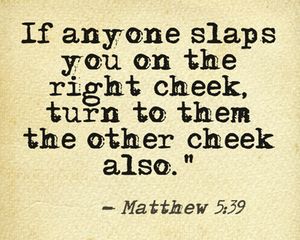
Turn the Other Cheek - Matthew 5:38-39


Turn the Other Cheek – Matthew 5:33-42 | Reading Acts


Sunday, June 14, 2020

          I had a moment when I had to decide what mattered more, my position on an issue, or my love for my friend.  I believed anyone in the United States illegally was a criminal, and should be deported.  I was unflinching in my resolve.  Then, I found out that one of my closest friends was in America illegally.   Fernando was my brother in Christ.  Truly seeing him my attitude toward the immigration changed.  I share this not to sway your view but rather to invite you to pause.  Regarding any issue, see the human beings involved, God’s image bearers. 
          I had prejudicial LGBTQ-related opinions, but then became close friends with gay people.  I have seen the fruit of the spirit produced in the lives of gay Christians.  I still hold what I think is the Biblical view in this conversation, but I tremble as I hold that view, and I appreciate the tension.  I am as much a sinner in need of love as anyone.  Jesus came to love me and calls me to love people – those who agree with me, those who despise me, those who hold me in contempt, and even those who would attack me.
          Matthew 5:39 is among the most challenging of Jesus’ teachings.  The life of a disciple is more demanding that other paths we might choose.[i] Jesus is not looking for believers, converts, or admirers.  He doesn’t have a logbook where he charts church attendance, hours spent reading the Bible, and how much Christian music we listen to.  Jesus calls disciples.  If you have any interest in the way of Jesus, listen.  Pay attention.  This demanding life?  You’re called to it.
          “If anyone strikes you on the right cheek, turn the other also” (Matthew 5:39a).  Much ink has been spilled by theologians and pastors trying to wriggle out of the full implications of Jesus’ word.  He couldn’t have really meant let people punch you.  Could he?  There’s has to be some deeper explanation that frees me up from actually applying this to my life. 
You don’t think Jesus meant it?  Read any of the Gospel accounts of him being arrested.  He was punched.  He had thorn hammered into his head.  He was flogged and his hands were pierced.  When he was arrested, Peter whipped out a sword and chopped the ear off one of the assailants.  Peter did what you or I would do.  He hit back.  Jesus’ harshest rebuke that night came against Peter as Peter defended him.  He healed the man’s ear and said to Peter, “Do you think I cannot appeal to my father, and he will at once send me more than twelve legions of angels” (Matt. 26:53; Jn 18:10-11)?  But he didn’t lift that prayer and no sword-wielding angels came.  Jesus turned the other cheek.  He talked the talk in the Sermon on the Mount and walked the walk in the Garden of Gethsemane. 
He expects us to follow his lead, but how do we do that?  And what does it look like in our lives?  I don’t usually have people actually try to punch me.  I think it last happened in the 1980’s.  I was a school kid and I punched back.  What does the turn the other cheek look like in a disciple’s actual lived experience?  The answer lies in our attitude and in how we see people.   We will act out of who we are.  Who defines who we are? 
If we want to follow Jesus, we have no role models in the White House.  There’s a cut-up video montage of all the times President Trump has threatened to punch someone in the face, wished he could punch someone in the face, or urged his supporters to punch someone in the face.  This is literally the opposite of what Jesus teaches.  It’s not just him.  President Obama killed far more people than Trump through the drone strikes he so often ordered.  Before him, President Bush sent thousands of Americans to wars in Afghanistan and Iraq.  What do we have to show for it?  Before him President Clinton bombed Serbia. 
A lot of church-going people feel emboldened by face-punching bravado.  It shows the difference between a church goer and a disciple.  The disciple takes his cues on how to deal with conflict and react to aggression from Jesus’ words.  The disciple follows the example Jesus modeled. I have cited two Democrats and two Republicans who fell woefully short of the standard Jesus set.  It is more demanding to be a disciple of Jesus than to be a draped in the flag, no matter what country or ideology one defends.  We belong to Jesus.
Is it possible for us to see as he sees?  Whether it is emotional or physical, threat takes over your body.  You feel your heart race.  Your throat gets dry.  Your brain starts to kick into fight, flight, or freeze.  You can’t control that.[ii]  You can train yourself to be more willing to fight that flee, but it is another matter altogether to rewire your brain so that you, like Jesus, can rhetorically or literally turn the other cheek.  Only with commitment to the way of Christ and the help of the Holy Spirit can this way of seeing be ours.  Fortunately, we can choose to commit to the way of Christ, and the Holy Spirit does want to help us.   
How then, can we see threats differently?  How can we see with the eyes of Christ and respond in love?  Get to know God.  Especially understand that God sees you.  Look to the story of Hagar in Genesis 16 & 21   
Sarah, over 80, growing impatient for God to fulfill his promise of offspring, told Abraham, over 90, to lay with her Egyptian servant Hagar.  He did, and Hagar got pregnant and had Ishmael.  She was of a different ethnic group than what would become the Jewish people.  She was Gentile.   Once Isaac was born to Sarah, she no longer had use for Hagar or the boy Hagar had by Abraham.  So, she convinced Abraham to kick Hagar out of the community. 
We humans do this too easily.  We deport the unwelcome foreigner.  We call the police when someone looks like they don’t belong in our neighborhood as the neighborhood belongs to us is ours, and it’s our prerogative to decide who belongs and who doesn’t.  It’s a selfish, self-righteous, arrogant attitude.  
Now consider God and Hagar, the Gentile.  Her child Ishmael only existed because Sarah and Abraham did not trust God and saw her, a slave, as property to be used, not a human being to be respected.  Kicked out, about to die of thirst in the desert, Hagar heard God speak.  He provided food and hope.  She did not die.  Hagar called God “El-Roi,” the God who sees (16:13).
That God came to earth in human flesh, Jesus.  Jesus was fully human.  He was able to love those who attacked him because he spent his life studying the scrolls, God’s word, praying, and seeing people the way God saw Hagar.  He trained his own brain to react differently to threats than we naturally do.  Instead of his brain automatically, in a matter of nanoseconds, running through fight/flight/freeze options, he saw the other person. 
He saw the angry mob ready to stone the woman caught in adultery.  He saw the man tormented by 1000 demons.  He saw the humanity in Pilate even as Pilate condemned him to death.  When you or I are prepared to strike someone, we see a target; the other’s face; the other’s gut; the other’s status; the other’s vulnerability.  We see “other” and we see a target.  When Jesus sees another, even if that other is throwing a balled up fist at his face, he sees one made in the image of God and he loves that person.  His decision to turn the other cheek is an invitation to the other to stop being an ‘other’ and instead become a neighbor. 
We are called to see as he sees.  “I say to you,” Jesus says to each one of us, directly into our hearts, “Turn the other cheek; go the extra mile; do not refuse anyone.”  Theologian, Miroslav Volf, writes “No one can be in the presence of God the crucified Messiah for long without overcoming the double exclusion – without transposing the enemy from the sphere of monstrous inhumanity into the sphere of shared humility and without transposing herself from the sphere of proud innocence into the sphere of common sinfulness.”[iii]
We can see the other and ourselves and God because Jesus has died on the cross and freed us from sin.  We aren’t locked into punching others in the face, or sending out murderous drones, or marching off to war, or fiercely defending our identities and egos in the Facebook comments section.  Neither country nor identity nor status owns us.  We belong to the Crucified One.  In bondage to Him, we are free.  When we turn the other cheek, we exercise our freedom.  We live in it.  We take the initiative to show grace – to mark the world with the grace of Jesus.  We begin stepping out of this present, dying age, and into the new age, the Kingdom of God.
How does this play out daily in our lives?  Will you accept being handcuffed by retribution.  If you insult me, I must punch you.  I punch you, then you must sue me.  You go after me, and I attack you someone you love.  Where does it end?  Where is Jesus in any of that?
Or, will you and I live in the freedom we’ve been given?  Will we stop and see the “others” around us?  Are they rioters, or are they people in pain?  Does the other spout offensive politic rhetoric?  Can I respond with kindness and love?        How can God rewire your brain so that instead of fight, flight or freeze, you see others?  Pray about it this week.  Who does God want you to see?  Your black neighbor?  You gay neighbor?  You Republican neighbor?  Pray about that this week.  You are disciple of Jesus.  Commit to his way, demanding as it is, and live in the freedom he gives.
AMEN


[i] F.F.Bruce (1996) in Hard Sayings of the Bible, by Walter Kaiser Jr., Peter H. Davids, F.F. Bruce, and Manfred Brauch, Intervarsity Press (Downers Grove, IL), p.362.
[ii] Carolyn E. Yoder (2019), chapter 4 in When the Center Does Not Hold: Leading in an Age of Polarization, Fortress Press (Minneapolis), p.70-71.
[iii] M. Volf, Exclusion and Embrace, Abingdon Press (Nashville), p.127.