Total Pageviews

Showing posts with label Divisive Politics. Show all posts

Wednesday, January 26, 2022

Pastor Rob recommends ... (January 26, 2022)

Pastor Rob recommends …


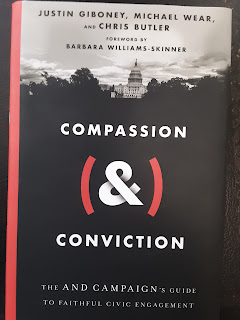
Compassion (&) Conviction: The AND Campaign’s Guide to Faithful Civic Engagement

By Justin Giboney, Michael Wear, and Chris Butler (2020)


The authors offer a brilliant argument for the way Christians in America can and should participate in politics and civic life.  Their political expression is an extension of their faith and is rooted in scripture.  Truly Christian political participation cannot be partisan.  It must be faith-based, and these authors makes this point beautifully and thoroughly.  Have your Bible ready when you read this book.   If you engage with the scriptures the way the authors do, you'll find their conclusions to be on solid ground, you'll be ready to follow their guidance by participating in public life yourself, and by doing it as a follower of Jesus.


Monday, November 23, 2020

"Put the Rock Down" (Mark 11:20-25)


watch it here - https://www.youtube.com/watch?v=zRSrSUQE9S8&t=2s

Sunday, November 15, 2020


            What can we contribute to the public good?    Ah, so many questions.  Who do I mean by ‘we?’  I mean the church – Hillside, a local congregation, and believers nationwide and worldwide, the community of faith.  What about, public good? By that I mean the people of the community – the public.  By ‘good,’ I mean conditions that enable as many as possible to thrive. 

‘Good’ would be a reduction in poverty and elimination of food and housing insecurity.  If people aren’t worried about eating or having a roof over their heads, they can concentrate their money, energy, and time on living an enriching life.

‘Good’ refers to relationships.  Everyone is fighting right now.  People fight about wearing masks or not wearing masks.  People condemn each other over politics.  In one family, a woman was on one side of the Biden-Trump divide, opposite her cousin.  Discouraged, she overlooked a lifetime of close family bonds and declared they have nothing in common but that their mothers were sisters.  In another case, two brothers, both over 60, refuse to talk to each because one called the other a ‘socialist.’  ‘Good’ is the repair of these fractured relationships.

Do ‘we’ – the church – have any responsibility for the ‘public good,’ for feeding the hungry, helping those who struggle, and bringing together those who have turn against each other?  Does God call us to be the voice of healing and hope? 

Yes.  In 2019, our elders and deacons adopted the slogan – “At Hillside, we follow Jesus, love others, and share hope.”  We know we are living into this motto when our actions as a church lift people from despair and draw them to Jesus.  Hence the question, what can we contribute to the public good?

We have a lot to contribute!  Love, eternal hope, joy, purpose.  This morning, we focus on forgiveness.  Forgiveness is not a uniquely Christian idea.  Other faiths teach forgiveness.  People who have no faith find it in themselves to offer it. The distinct Christian gift to the world is the message of Jesus.   

We can’t present a Christianity that doesn’t include forgiveness as a core value.  Expressing divine love is what we do.  They know we are Christians by our love.  What can we offer, to contribute to the public good?  Forgiveness!

Jesus tells his disciples, “When you stand praying, forgive if you have anything against anyone; so [then] your father in heaven may also forgive you” (Mk 11:25).  He says this after having ridden, on Sunday, into Jerusalem on a donkey with admirers shouting “Hosanna.  Blessed is the one who comes in the name of the Lord.”  From Monday to Thursday of that week, he will teach in the outer court of the temple.  It’s as if he is piling on the lessons, deflecting challenges, and sharing final instructions before he will die.  Could you or I focus knowing that heartbreaking betrayals and gruesome suffering and death lie immediately ahead?

On one of the trips to the city from where they stayed in the outlying village of Bethany, Jesus sees a fig tree with no ripe fruit on it; even though it is not the season for figs, he curses the tree.  It’s a prophetic act akin to Isaiah walking across the city barefoot and Ezekiel lying on his side for 300 days.  Prophets did odd things so their listeners would remember more vividly their message.  People didn’t just remember John the Baptist’s sermons; they remembered his coarse clothing, his diet of honey-covered bugs, and river baptism.  Cursing the fig tree caught the disciples’ attention.

When they walked that way the next day, Peter marveled that the tree had withered overnight (11:20-21).  Not batting an eye, Jesus says to Peter and the disciples, “Have faith in God.  Truly I tell you if you say to this mountain, ‘Be taken up and thrown into the sea,’ and if you do not doubt in your heart, it will come to pass.”  Jesus did not hate fig trees and he did not want to change Jerusalem’s topography.  He wanted his disciples, us included, to understand that prayer makes a difference.  God listens.  When we pray in faith, God’s power comes. 

Note the connections.  The fig tree represented the system of sacrificial worship.  Sin separates us from God and the sacrificial worship system could not overcome the damaging affects sin had on God’s relationship with human beings.  That system did not produce righteousness or salvation as its fruit.  It was fruitless, like the condemned tree.  Jesus later on makes a similar point when he talks about tearing down the temple.  When he says he will rebuild it, he’s talking about his resurrection.  The temple no longer produces the fruit of new life.  That can only be had through faith in him. 

After teaching about mountain-moving prayer, he connects forgiving others with receiving forgiveness from God.  Of course, God’s forgiveness is not conditional.  God doesn’t forgive us if we forgive each other.  Jesus hung on the cross abandoned by his followers and berated by his despisers.  No one repented as he suffered.  His death, for everyone, was God’s definitive declaration of love for humanity.

The reason Jesus ties forgiving each other to the forgiveness that comes from God and to the replacement of temple-worship with the worship of Jesus is the posture of receiving.  Every time you or I forgive each other, it’s a sign we have received God’s forgiveness.  We don’t just talk about it.  We stand as new creations, forgiven being.  God’s grace takes affect when we receive it.  Standing as forgiven ones, we cannot withhold forgiveness. We are not able. 

The corollary holds as well.  When we withhold forgiveness, it’s a sign we have not received the forgiveness Jesus achieved on the cross and freely offers to all.  It’s there, but we can’t believe it or we are too locked in our shame.  For some reason, we cannot gain release from our own sins.  We can’t allow ourselves to receive the forgiveness God lovingly gives.  So, we can’t forgive others.  We are bound, chained, by our sin and the sins of others.

  Jesus is the truth that sets us free.  We share Him with the hurting world around us.  Why does polarization win?  Why let partisan division claim the day?  Why does animosity, revenge, and discord get the last word?  We tell of God’s forgiveness.  We model it, and in doing so, we step into freedom. 

Those who accept our invitation and turn to Jesus also take the first step to freedom.  Freedom spreads through the church, and out to the world.  It is not easy.

Immaculee Ilibagiza survived the Rwandan genocide of the 1990’s.[i]  She and several other Tutsi women crammed into the bathroom of a man who hid them from Hutu neighbors determined to wipe out all Tutsis.  The conditions were unimaginable, yet, she and the others survived many months in the impossibly cramped quarters.  Immaculees’ parents and most of her siblings were massacred. 

Survival was only part of the miracle.  The bigger part came in Immaculee’s determination to find it in herself to forgive the Hutus, including her family’s killers.  In order for her to reclaim her own humanity, she had to see the humanity in these who had performed such evil.  By God’s grace, she claimed freedom by forgiving those who took everything from her. 

Bishop Desmond Tutu of South Africa touches on this in his work The Book of Forgiving, written with his daughter Mpho.  South Africa, for over a century, existed in a system of Apartheid as evil as slavery, Jim Crow, and mass incarceration here in the United States.  Blacks in South Africa, the majority, had no rights, and lived in extreme poverty, as servants to the whites who held the money, guns, and power.

When revolution came in the 1990’s, it could have been deadly for the white minority.  But the black citizenry, following the example and lead of people like Bishop Tutu and Nelson Mandela, committed to forgiving and moving forward together.

Tutu proposed an exercise for the reader of his book.  First, select a stone and remember where you found it.  Then, one morning, carry it, the entire morning, never setting it down for any reason.  Do this for six hours.  That stone is the pain you are holding, the wrongs done to you that still have you in their insidious grip.  Oh, to put that stone down.  Oh, to be free from that pain, the loss, and injustice. 

Let it go.  Forgive.  There will be time for justice if that’s called for.  An abused wife should not just forgive the abuser, stay with him to endure more beatings.  The robbery victim should hope to get back what was taken.  The criminal must be prosecuted.  That’s all another conversation; an important one, but another one.

In terms of forgiveness, release the offender as Jesus releases you.  Set the rock down.  Open your arms in embrace.  This is emotional work, psychological work, and soul work.  But, think of that rock – the way it weighs you down and impedes your progress in life.  Look to the cross where Jesus bleeds out the death brought about by your sins.  Receive his forgiveness and extend it to someone.

Think of someone who’s deeply hurt and angered you through this election season.  You think you’re taking the Christian position.  He thinks the same thing.  You’re frustrated by his politics and he by yours.  Set that rock down. 

This is one of our offerings to the world, church.  It’s the way of grace and it’s sorely needed.   Let love win.  Walk in freedom.  Forgive and invite your neighbor to walk in freedom with you.

AMEN


[i] I. Iligabiza (2006), Left to Tell: Discovering God Amidst the Rwandan Holocaust.


Monday, September 28, 2020

"Great Commandment Politics" (Mark 12:28-34)


Watch it here - https://www.youtube.com/watch?v=zAViBZ0Kkmg

Sunday, September 27, 2020


            Our politics must be tied directly to the great commandment.  The Great Commandment only makes sense if we understand God intends to say everyone.  Jesus went to the cross because “God so love the world;” not part of the world but all of it, everyone. 

            What is the ‘Great Commandment?’  From the mouth of Jesus, “You shall love the Lord your God with all your heart, with all your soul, with all your mind, and with all your strength.”  He’s quoting Deuteronomy 6:4. This has been God’s top priority for us from the beginning.  Next, quoting Leviticus 19:18, Jesus says, “You shall love your neighbor as yourself.  There is no other commandment greater than these” (Mark 12:29-31). 

            Wait, wait!  Time out, Jesus.  We wanted 1 – the greatest commandment.  You gave 2!  He’s allowed to do that. He’s Jesus.  He gives them together, because we can only understand them together.  We can only truly love God when we love our neighbor.  It is impossible to truly love God if we fail to love our neighbor.  So, racism, conscious or unconscious, makes it impossible to love God because it is a failure to love our neighbor.  Holding others in contempt, for whatever reason, makes God-love impossible.  If you hold someone in contempt, you have elevated yourself above him; you have failed to love him.  Loving God means loving people.  The way we approach politics shows whether or not we truly love people. 

            I don’t mean the American political scene.  It is abhorrent when churches and pastors align with one party or the other, or a third party.  Many in our church family and many listening to this have strong political convictions which may lead you to hear this message and conclude I am against your party or for your party.  It’s not so.  I am not advocating for or against any candidate or party. 

Partisan politics have no place in church.  This is God’s time.  We have to contemplate how God calls us, His church, to relate to each other and to the world.  Politics refers to people.  So, as Christ-followers, our politics have to be love-based.  It’s the only way Christ allows.  Of the many significant obstacles to love, I will briefly touch on 3, using as a source chapter 4 of the book Crossing the Lines we Draw by theologian and pastor Matthew Tennant. 

First: fear.  Fear drives us to objectify others.  Fear prevents us from seeing others as people – people God calls us to love.  Fear leads me to hoard resources and prevents me from sharing.  I forget that we all need food, shelter, healthcare, clothing, and community; instead, I make sure I have enough.  I even store extras to make sure I’ll have more than enough in the future.  Fear turns my generosity into greed as I ignore everyone else and look out only for myself. 

Tennant uses the example of terrorism to illustrate the way fear distorts our perspective.  He quotes an American politician who, a few years ago said, “We will … unite the civilized world against radical Islamic terrorism, which we will eradicate completely from the face of the earth” (p.41).  It’s a patently absurd statement because terrorism is a technique, not an individual or even a group.  Most Muslims are not terrorists.  Many terrorists are not Muslim; some are white American.  But fear leads us to demonize radical Islamic terrorists, whoever they are.  Fear leads us to objectify groups of people or regions of the world. 

In Matthew 5 Jesus says,  “I say to you love your enemies and pray for those who persecute you. … If anyone strikes you on the right cheek, turn the other also” (Matthew 5:44, 39).  That’s the Jesus, red letters!  His teaching and his commands get drowned out by the illogical noise our fears produce.  So, who do you fear?  Protestors or looters?  Political liberals or conservatives? Submit your fears to God. Ask Him to give you the courage to love those you fear or hold in contempt.  Empowered by the Holy Spirit, we overcome fear by, loving those we would never love.  The ‘other’ is no longer an object of our judgment, but instead a recipient of our love.

A second obstacle to Great Commandment politics is the sense that life is a zero-sum game.  Tennant points out a zero-sum game requires winners and losers (p.49).  For you and I to be winners, we have to beat others.  We advance at the expense of others.  A zero-sum game favors individual advancement over cooperation and mutual gain. 

Picture it.  Five thousand people on a hillside have listened to Jesus for hours.  His words are so rich, no one will leave.  Practical-minded Philip, one of the 12, wants to know how they’re going to feed this crowd the size of a small town (John 6:5).  Andrew, the matchmaker of the 12, sees a kid munching a loaf of bread. 

“A lot of hungry people here,” he says to the kid.  The kid nods.  “You going to eat all of that?”  Andrew asks. 

The kid nods yes. Then he says to Andrew, “At least I got mine!”

That’s not how the story goes!  The kid offers to share his lunch, and we get to see the way God multiplies our small offerings; Jesus miraculously feeds 5000 people with one boy’s meal.  We give what have to support each other and help those with nothing, and God multiplies it.  This is not socialism; this is Great Commandment politics.  Share.  Give.  Make sure everyone is included, cared for, and empowered.  Guided by love, we reject the zero-sum game approach and instead look for ways we can give of ourselves for the good of others.  Jesus gave his all for us on the cross.  We imitate Him, our savior, by giving of ourselves.

So far, in connecting love with politics, we have seen two movements.  We reject fear by seeing the “other” whomever we mean by “other” as someone to love, not someone to despise.  Second, we reject the competitive idea of a zero-sum game in favor of cooperation and mutual blessing.  We do this by sharing and trusting God to take what we give and bless others with it.  What’s third obstacle to love we need to overcome?  False narratives. 

Tennant refers to a couple TV shows from the 1950’s, Ozzie and Harriet, and Leave it to Beaver.  Both are fine shows that depict an idealized America, if idealized America is a 1950’s white, working class nuclear family: mom, dad, two kids.  Sometimes this era is referred to as The Greatest Generation.  This is the generation of my parents and my grandparents.  However, the picture is of a particular type of family situation; but that’s not the only picture from that time period.

America back then was great, for some people; not for all.  Read the history of how stridently white people all over the country, not just the south, but all over resisted integrating public schools.  If you have a conscience and you’re willing to honestly read the history, you’ll be horrified.  Read about the racism against Asians coming to America during that time.

Tennant also points out that these beloved old shows fail to delve into the depths of Appalachia and the Southern literary tradition, a white cultural heritage that went ignored.  What makes America “great” is in the eye of the beholder.  As followers of Jesus, we have to tell the truth in the face of distorted narratives. 

The 1950’s, the 1980’s, today – none of it is a golden age.  Until Jesus returns, the world is a fallen place where women and men of every nation are lost and dying in sin, cut off from the love of God, cut off by their own choices.  The politics of love drive us to tell the truth about sin.  The politics of love compel us to help people find their way to the Savior, our Lord, Jesus.

We overcome fear by committing to love, even love our enemies.

We reject the zero-sum game in favor of cooperation and mutual blessing.

We expose false narratives by speaking the truth in love, even when the truths we expose are inconvenient and uncomfortable. 

Love of God and love of neighbor comes to full fruition in the most quoted of Bible passages, John 3:16-17.  Jesus says, “For God so loved the world that he gave his only Son, so that everyone who believes in him may not perish but may have eternal life.  Indeed, God did not send the son into the world to condemn the world, but in order that the world might be saved through him.”

“The world” means everyone.  That so-called radical Islamic terrorist; Jesus wants to be with him for eternity.  That person in Portland you saw on the news, the one throwing a Molotov cocktail at the police; Jesus loves him.  That Aryan white supremacist advocating for the purity of the white race; he’s shouting, red-faced, at an antifa protestor, who shouts right back, louder.  Jesus died for them both.  Jesus died for George Floyd and Derek Chauvin, for Michael Brown and Darren Wilson, for Trayvon Martin and George Zimmerman.  God so loved the world, means everyone.

The cross shows that Jesus is for everyone.  Do you want to stand with Jesus?  You can stand against racism, against terrorism, and against hatred.  We are for people – black people, Arabic people, southern whites, Yankees, Canadians, Republicans and Democrats, everyone. 

Jesus gives the Great Commandment to love God and love people in the midst of a series of contentious public debates.  He debates with Pharisees, Sadducees, and a group called Herodians.  Each group attempts to outsmart Jesus and catch him in some inconsistency.  Like today’s political reporters, they try to trip Jesus up, but they always fail and end up with egg on their own faces. 

One guy though, described as a “scribe” (Mk 12:28), most likely a Sadducee, asks Jesus a legitimate question.  Which is the greatest commandment?  Jesus tells him he must love God and love neighbor.  A light goes on in this Sadducee’s mind.  “You’re right, teacher,” he says.  Jesus can see that unlike the others, his heart is true and Jesus says to the scribe, “You are not far from the kingdom of God.”

That’s where I want to be, close to the Kingdom.  I want you there with me.  Commitment to the Great Commandment puts us on the path.  Right now, our country is mired in the worst of political seasons.  It’s an opportunity for us to bear witness to the goodness of God by sharing the love of Jesus, in our thoughts, our words, and our actions.  May we do that.  May we obey the command to love, answer the call of love, and win people over to Jesus with hearts, words, and deeds of love. 

  AMEN

Monday, June 29, 2020

Identified with Christ


Of Random Acts of Kindness and Social Media — Steemit 

         To be identified with Christ is to embody specific attributes.  The New Testament enumerates many of these traits in “virtue lists” found throughout.  For instance: 2 Timothy 2:24-25.  “The Lord’s servant must be … kind to everyone, an apt teacher, patient, [and] correcting opponents with gentleness.  The Christian does not have the option of withholding kindness or opposing others harshly.  Kindness and gentleness are mandated by the word.

          Of course, we see people claiming the title ‘Christian’ lash out in judgment, villainizing those who disagree with them.  Such behavior disregards the New Testament these very Christians would herald as the “word of God.”  Those guilty of withholding kindness and gentleness clearly are not actually connected to Jesus, who gently welcomed the tax collector, the prostitute, the physically disabled, and the morally corrupt.  Why did Jesus treat his opponents so differently that those today, who claim to be his followers?

          Similarly, look to 1 Peter 3:9: “all of you, have unity of spirit, sympathy, love for one another, a tender heart, and humble mind.”  Again, the label ‘Christian’ inherently calls for full submission to the dictates of the word.  Christians don’t have the option of being unsympathetic, arrogant, or rough.  To speak and act in a bullying, abrasive manner is to reject the Bible’s authority. 

          Numerous other virtue lists round out the picture of one who truly follows Jesus.  For better understanding, begin reading in Matthew chapter 1 and keep at it through Revelation chapter 22. 

          Christians in America stand at a five-way (at least) intersection where divergent COVID-19 responses, reckoning with generational & structural racism, bipolar presidential politics, instant feedback on social media, and one’s personal identity all collide.  In this maelstrom of words and assaults, what is the Christian’s posture?  We know from the virtue lists: when attacked or offended, we are to be humble, kind, gentle, and sympathetic.

          Consider the specific arena of Facebook.  Is Jesus defiantly posting memes to assert his rights?  Well, he never asserts his rights in the Bible, so why would he do so on Facebook?  And if he wouldn’t why do his followers?  To act in a way differently than Jesus, indicates the individual isn’t really following him. 

          Zero in on the example of someone who feels offended, hurt, or scared.  Does one respond to someone else by defending one’s own right to say or do or post what made the other feel offended, hurt, or scared?  If so, that one isn’t communicating in the way Jesus did, and thus is not a ‘little Christ,’ even if he or she claims the moniker ‘Christian.’  A black person feels threatened or hurt; the white person tells the black person not to make a deal out of it; or, not to see race in everything; or, to get over it and move on.  Obviously that white person is not walking in the way of Jesus and thus is not ‘Christian’ regardless of his or her claims. 

          To the black person who feels wounded, Jesus says, “I proclaim release to the captives” (Luke 4:18b); and, “I will give you rest” (Mt. 11:28); and, “my peace I give to you; do not let your hearts be troubled” (Jn. 14:27).   Jesus welcomes all who are broken, all who are repentant, and all who seek truth.  Jesus will give success to the white or Asian or black person who strives to embody kindness, gentleness, welcome, and the other virtues.  He will guide the lost and fill the hungry.  Christians don’t need to be super saints; they only need to die to self and live in Christ.

          Christians embodying Christ will affect the community; working through His church, Jesus will bring change to the way people interact.  But that won’t happen when Christians are more caught up in defending their identities and asserting their rights than in exhibiting his holy gentleness and kindness.  When Christians, on Facebook and other platforms, act as combatively as anyone else in society, they actively suppress the positive force of the Gospel.  Christians acting like the world instead of like Christ hurt the world as much as anything.

          Christian reader, does the Bible have authority?  Are Christians bound to live by the word?  Do Christians understand that choosing to walk in the way of Christ means one chooses to relate to others gently, humbly, kindly, and sympathetically, even when those others are obnoxiously confrontational?  To find out if Christians understand these things, look at their Facebook posts and Tweets. Look for Christ in what people express in their social media communications.  Holding Facebook up to the virtue lists will reveal who is identified with Christ.