Total Pageviews

Showing posts with label Spiritual transformation. Show all posts

Monday, October 21, 2019

The Hope of a New Heart

Image result for jeremiah 31:31-34


Sunday, October 20, 2019

            There’s a distance so great, it’s hard for us over here to understand what they’re saying over there.  We need to!  We need what they have over there.  We are 21st century Christians.  They were Jews exiled in Babylon in the 6th century BC.  The word of God spoke to them through the prophet Jeremiah is also God’s word for us.  How can we receive God’s word when the context in which it was originally spoke is so utterly different than the life we live in the world as it is now?  How do we span the gap of many centuries and receive the word of God? 
            We can ask questions.
            What was exile like?  Jews forced into exile Babylon probably lived in cramped, unsanitary quarters.  Most likely, they had to work long hours in menial jobs with little pay.  They had no civil rights.  They had no civil services.  To survive, they had to depend on their captors, the ones who forced them to live like this.
            What is life like for us, Christians in America?  Many think Christians’ social influence has diminished significantly.  More and more people openly declare that they have no religion: the “nones,” so labeled because when asked their religious preference, they respond, ‘none.’  As Christians lose our public voice, we fight with we each other.  In some cases, Christians are openly hostile to one another over theological or more often political or moral differences. 
            Does any common thread tie us to the Babylonian exiles, the original recipients of Jeremiah’s prophesy?  The circumstances are clearly different, but in both communities, a couple of dynamics are in play.  The exiled Jews were powerless.  Christians today feel like our public voice has been almost silenced.  The exiled Jews feared they might not have a future.  They feared annihilation.  Some Jesus followers today, with much anxiety, wonder what the church of Jesus Christ will look like in America 100 years from now.  Will anyone proclaiming the gospel in the next century?
            Written so many years ago and so many cultures removed from us, Jeremiah still speaks to us.  Listen these promises from God found in the earlier verses of Jeremiah 31.  The exiles desperately needed God’s words to be true.  So do we.
            “The people who survived … found grace in the wilderness” (Jeremiah 31:2).
            The Lord said to Israel (and says to us, his church), “I have loved you with an everlasting love” (Jeremiah 31:3).
            Next, God promises.  “Again I will build you, O Israel.  Again you shall take your tambourines and go forth in the dance of merrymakers” (Jeremiah 31:4).
“Again you shall plant vineyards … and enjoy the fruit” (Jeremiah 31:5).
            “Sing aloud … and be radiant over the goodness of the Lord” (Jeremiah 31:12).
            God promises reversal of fortune.  “Their life shall become like a watered garden and they shall never languish again.  Then shall the young women rejoice in the dance, and the young men and the old shall be merry.  I will turn their mourning into joy.  I will comfort them and give them gladness for sorrow” (Jeremiah 31:12e-13).
            God’s heart breaks for His people.  Calling Israel ‘Ephraim,’ God asks, “Is Ephraim my dear son?  Is he the child I delight in?  As often as I speak against him, I still remember him.  Therefore I am deeply moved for him.  I will surely have mercy on him, says the Lord” (31:20). 
            What do we see in Jeremiah 31?  God delights in his child.  He is deeply moved out of love for all his children, including each of us.  The New Testament epistle First John, in chapter simply says, “God is love” (4:7, 16). 
            All of the early verses in Jeremiah 31 lead up to this promise.  “This is the covenant I will make with the house of Israel. … I will put my law within them, and I write it on their hearts; and I will be their God and they shall be my people” (31:33).
            I was touched as I read the comments of Old Testament scholar Gerhad von Rad in his reflections on this new covenant in Jeremiah, the covenant written on our hearts.  Von Rad sees this as something so unexpected that the change God brings about is complete and irreversible.  Once God plants his word in our heart, the written word is no longer needed and sermons are no longer necessary because, with the word planted in us, we no longer sin.  Von Rad says, “What is outlined here is the picture of a new man who is able to perfectly obey because of a miraculous change of his nature” (Rad, p. 182, 183).[i]
            Can he be right?  When God inserts His law in our hearts, does it mean we are able to perfectly obey God’s will?  Read everything in the Bible that comes after Jeremiah 31.  We know that’s not right.  We know people failed as disciples yet were God-worshipers.  We know God did not stop speaking after Jeremiah 31.  There’s a Jeremiah 32!  There are other prophets.  Jesus and Paul spoke.  Gerhard von Rad was a renowned scholar.  What was he saying as he thought about the new covenant described by Jeremiah? 
            I think the point he raises that we need to come to grips with is the idea that we become completely new.  When God writes the new covenant on my heart and on yours, we are no longer who we were.  The exiles had to learn how to be the people of God while in exile.  We live after Jesus came, died, and rose.  Our meeting with God comes through faith in Jesus as Lord as we meet Jesus in the Bible and through the Holy Spirit.  The Holy Spirit is God, leading us to confess Jesus.  Just as Jeremiah promised, God writes His will on our hearts. We become new creations (2 Corinthians 5:17).  The old me, the old you, has passed away.  We are made new in Christ. 
            In Romans 2:29, Paul likens this change to circumcision – the physical marker that indicates a man is truly of the people of God.  He writes, “Real circumcision is a matter of the heart – it is spiritual and not literal.”  That opens the way for non-Jews, uncircumcised people to be accepted as Jesus followers.  It also allows for women who don’t get circumcised to be marked as God’s people: marked by the Holy Spirit. 
But spiritualizing circumcision must not neuter the power of the image.  Circumcision is surgery, the most intimate form of surgery.  When God writes his law on our hearts, it is as invasive and bloody as when someone goes through surgery: open heart surgery. 
Does the change mean we don’t sin anymore?  Is that where spiritual growth leads?  This process used to be called sanctification.  Through our growth in Christ, we become so like him we become near perfect.  Is God able and willing to do that?  If the answer is ‘yes’ and God in Christ renders us perfect as the Father in heaven is perfect, can we still be said to have free will?  Or do we become spiritual automatons who don’t sin because we don’t have the choice to sin?
I don’t know.  I want to believe God’s promises, spoken by the prophet Jeremiah.  I go back to all those words hope in the early verses of chapter 31.  Finding grace in the wilderness; seeing mourning turned into joy; exchanging our sorrow for God’s gladness; I think about the most difficult experiences in life and I want this all to be true.  I want God’s law planted in me.  I want God to give me a new heart and to help me see the world that way He sees it. 
More than wanting it, I believe God does this!  Based on my experiences with God in worship, in meeting God in the Bible, in seeing God in my own private prayer time, and in encountering God as God is at work in the world, I know these promises can be trusted.  God does a new thing in each of us. 
I still believe in free will.  Jesus walked on earth.  People could touch God -in-the-flesh, yet they had the choice to reject him and many did.  He chose twelve disciples to walk with him and spend all their time with him.  No one knew him better.  They were Jesus’ inner circle, but they still had freedom, and they used it.  One denied him, one betrayed him, and they all abandoned him.  We can be ‘in Christ’ and still make mistakes.  The exiles had to choose.  Would they wallow in exile-misery or choose to be faithful God even in their circumstances?  Christians today, must choose to live as new creations with eyes fixed on God or to join the world around us and reject God. 
What is the path forward?
The exiles had to learn to worship God and live as the people of God in Babylon.  Another group of Jews was in Egypt.  The diaspora became the context for living faithfully. 
Christians in a world uninterested in God, in a world that glorifies the self must declare that Jesus Christ is Lord; Lord in our homes, Lord in our church, and Lord of the world.  So many signs point to a world that’s turned its back on God.  Violence run rampant; decreasing faith and declining morality in our culture; in the face of these and other signs of societal decay, we stand certain of this.  Jesus is Lord. 
That means we are always people of hope.  As Hillside Church, we follow Jesus, love others, and share hope.  Yes, Jesus died on the cross, but he also rose from the grave and promises to come again.  As we tell the good news about him, the Holy Spirit empowers us.  We are born-again, Spirit-filled people. 
Hope is God’s future for Hillside Church.  The reason we are in this neighborhood, in this town, at this time, ready to leap into the future with our new name and new calling is God placed us here with a mission and God calls us to fulfill that mission. 
Hope is trust that God’s goodness is without limit for those who choose to follow Jesus.  Through his prophet Jeremiah, God promised to write his word on our hearts.  We come before the Lord open, ready to be filled and sent out in his name.  It doesn’t matter how many people in our culture are believers.  We are sent to love all, believers and unbelievers alike.  We have the hope of a new heart and we are to share that hope.  The world needs it.
AMEN


[i] Rad, Gerhard von (1962).  The Message of the Prophets, HarperCollins (San Francisco).

Monday, December 17, 2018

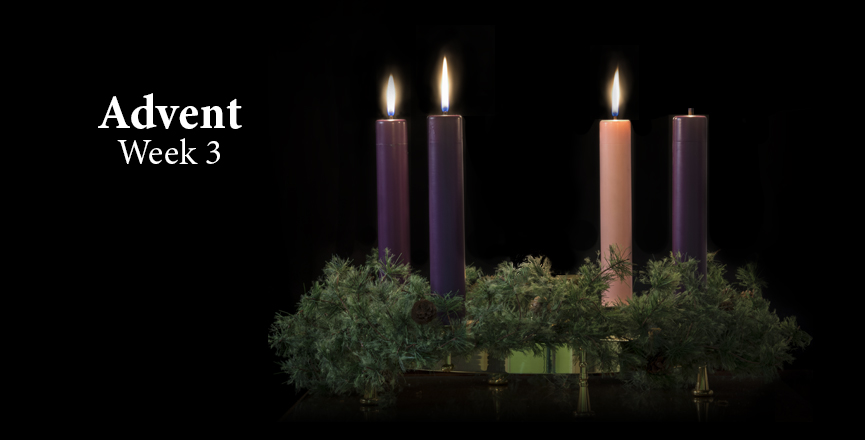
3rd Sunday of Advent, December 16, 2018 - Luke 3:7-18

Image result for advent 3


            Waiting ... for Christmas break; students get time away from class and some have jobs that allow time off from December 25th to New Year’s Day; .  
            Waiting ... for Christmas morning, gathering round the lighted tree as presents are excitedly opened and a special meal is shared with the family.
            Waiting ... for the stroke of midnight when we get to shout “Happy New Year.”  
So much of this season is built around waiting.
 This is unlike any other time of the year.  We stretch out our celebration of Christmas.  Some grumble that decorations go up too early, or complain that the holiday has become too commercialized.  In truth though, a lot of people feel a unique kind of specialness.  We hope that during the holiday season, people will act a little bit nicer.  People in financial distress call churches and charities hoping the generosity will be greater because it’s Christmas.
But, to me it feels weird to say we are awaiting the arrival of Jesus because he came already - 2000 years ago.  Thus our Advent scripture readings are infused with double meaning.  Our ancestors in faith awaited the Messiah; we await the Second Coming of the Messiah.  
As we do, we listen to the sermon of John the Baptist preached on the bank of the Jordan River in 30 AD.  What does the arrival of Jesus - his first coming - mean for us now  - in the living of our lives today?  Why is it important that Jesus was born?
“The word of God came to John, son of Zechariah, in the wilderness.  He went into all the region around the Jordan proclaiming a baptism of the forgiveness of sins” (Luke 3:2b-3).  John preached to everyone who came - the wealthy, the poor, the sophisticated urbanites and rough-around-the-edges shepherds and fishermen; his word was for Jews and gentiles.  To all he said, “Bear fruit worthy of repentance.” 
The Bearing of fruit metaphor was used both by John the Baptist and by Jesus as a way of describing what is produced in the life of a believer.  Jesus said in the Sermon on the Mount, “Beware of false prophets.  ... You will know them by their fruits. ... Every good tree bears good fruit and every bad tree bears bad fruit” (Matthew 7:15-18).  Jesus later says, “God removes every branch in me that bears no fruit” (John 15:1).
Fruit is a sign of growth.  When we lead others, those outside the faith, to meet Jesus, we are bearing fruit.  When we help new believers grow in their understanding of God, we bear fruit.  When we guide believers into new opportunities for mission and good works, bear fruit. When we meet people in great need and help them out of our own abundance, we bear fruit.  When, through study and prayer, we deepen our relationship with God, we bear fruit.  When we encourage people who are hurting, and when we walk with them through their trials, we bear fruit and grow as disciples.
Jesus’ very drastic statement is that when we do not bear fruit, our connection with him is severed.  God removes every branch that bears no fruit.  There’s no such thing as casual faith.  We grow as disciples or our faith is dead.  “Bear fruit worthy of repentance,” John preached.  Repentance, of course, is making that full turn away from the temptations and cultural trappings of the world around us and turning fully to God.  Repentance is the most radical change one can experience.   “Every tree that does not bear good fruit,” John preaches, “is cut down and thrown into the fire” (3:9).
Anyone who takes the word of God seriously would, at this point in the story, come to two conclusions.  First, being thrown into the fire is judgment.  It is the state of being cut-off from God.  Failure to bear fruit, failure to live an active faith, is equal to calling judgment down on ourselves, and we do not want that.  We do not want to face life without God, much less face eternity after death without God.  The second conclusion is, we have to ask how do we avoid this judgment?  That’s what the crowds hearing John wanted to know. 
In 3:4, Luke describes who John is and what John is doing, Luke quotes the prophet Isaiah, “Prepare the way of the Lord, make straight his paths.”  John is the one preparing the way and Jesus is the Lord.  Because Jesus has come, everything has changed.  That’s why John issues the call for repentance, and that call involves changing is what our lives are about.  
What must we do?  The crowds asked that question and John offered a ready, practical response.  “Whoever has two coats, share with any who has none.  Whoever has food, share with anyone who is hungry” (3:11).   Judgment does not have to come for us.  It’s coming, and will be harsher than we can imagine and will be final.  God’s judgment is to be feared because God is holy and will not tolerate sin and every one of sins.  But, John offers a lifeline.  Share with each other so that no one is freezing or starving or crippled by poverty.
“What should we do?”  Tax collectors asked.  They collected taxes imposed by the Roman empire.  Roman soldiers would force peasants to pay whatever the tax collectors demanded.  Most tax collectors demanded higher amounts than Rome required, and got rich pocketing the difference.  They were thieves. 
What should we do?  John doesn’t tell them to quit the tax collecting business.  He says, “Collect no more than the amount prescribed.” In other words, work ethically.  What does that look like in your job?  Where you work, away from the church, in the world - that’s where your discipleship is on display.  It doesn’t mean you’re always talking about Jesus.  Sometimes we do.  At other times, you do your secular work to the very best of your ability and you do it honestly.  When we live in integrity, we bear fruit.  When we treat people around us with kindness, we bear fruit worthy of repentance.
“What should we do?”  Soldiers asked John.  The soldiers were charged with maintaining order.  They possessed unchecked power.  They could bully the people and take what they wanted, and they did.  What should we do asked these soldiers who felt convicted by John’s words.  
“Do not extort money by threats,” he answered.  “Be satisfied by your wages.”  He didn’t tell them to quit the military.  John did not impose pacifism as a rule for God-worshipers.  In fact, his answer implies they would go right on being soldiers, work that is by nature violent. But, if we take the bullying, the threats, and the intimidation of common folk out of their work, then soldiers are responsible protectors who can be respected and even admired.  When we use whatever power we possess for good, to help people, to contribute to people’s flourishing, we bear fruit.  Sharing, acting ethically and honestly, and protecting and helping are all ways we can, in our lives, bear fruit worthy of repentance.  We choose to live this way because Jesus has come. 
His coming, His Advent, is a sign that God’s judgment is coming.  We take that seriously and know that on Judgment Day, if we have to stand on our own merit, we’ll be found lacking.  So, we repent.  We live to worship God and help others.  We acknowledge God as Lord throughout our lives, not allowing any aspect of life to be secular, apart from God’s rule.  And then, we trust God.
John knew that Jesus, and not he, was the Savior and Lord.  “I am not worthy to untie his sandals” he says (3:16).  He baptizes with the Holy Spirit.  He will judge, collecting the good fruit and bringing it into God’s house, and casting the bad out to be burned, cut off from God.  We can’t control that harvest.  We can’t determine if we will be saved or judged.  God judges and we are at God’s mercy.
So John, offers something we can all do in our lives, right now as we wait.  Because Jesus has come, we can share, be honest, be ethical, be kind, and be compassionate.  With the help of the Holy Spirit, we can live as people of the Kingdom of God even while we live in the world, fallen as it is.  And John promises the help of the Holy Spirit because Jesus baptizes us in the Spirit and Jesus has come.
As we wait for His second coming, we live in the reality of His first coming.  Our lives are different than the lives of non-believers because the Spirit is in us.  The world needs us to be different just as the world needed things to be different when Jesus was born.  
So, find someone with whom you can share.  Find a hurting person in need of encouragement, or a lonely friend in need of compassion.  When your peers cut corners on the job, express your repentance by working ethically.  And the when the opportunity is there, tell someone about why Jesus is your Lord.  Invite someone to come to worship with you.  This is the Advent fruit we have to share.  And people are hungry for it.
AMEN


Saturday, August 26, 2017

Hard Turnarounds

            Here, I quote a little-known, unpublished but prolific writer (perhaps completely unknown).
            “[I’ve learned that] I … need to see with new eyes, but that seeing won’t come through mega-lessons.  It comes through simple lessons, new vision through the two G’s, gentleness and grace.  I have to be gentle, and to be gentle, I need to give grace.”[i]
            Of course the writer is me.  I am quoting myself from earlier this month, August, 2017.  This past week, I saw a picture of the enormity of the task I’ve set before myself – turning to become truly gentle and grace-giving. 
            For a second straight year, my family, my immediate family plus niece and nephews, parents, sister and brother-in-law came together at First Landing State Park, Virginia Beach, VA.  For a second straight year, we occupied cabins 18, 19, & 20.  There are only 20 in total.  The road to the cabins takes a sharp right curve after cabin 17 so that our three cabins, 18-20 are tucked back into their own space.  And the road doesn’t go through. It ends after cabin 20.  No one has any reason to be back there unless they’re going to 18, 19, or 20.
            However, people don’t know that. All the time, people come back there and discover – oops! – I need to turn around.
            That’s usually fine, but not last Wednesday.  We were gathered in the afternoon in one of the cabins playing Nerts.[ii]  A huge camper with Harley Davidson in large letters came through – except you can’t come through.  That incredibly long thing had to turn around and there just wasn’t space. 
            I exited out cabin to greet the harried, stressed, tattooed 50ish woman driving the monstrosity and tried to coach her through the 25-point about face.  It was an ordeal.  She screamed, she ignore me, she waited until too late to follow my directions, she demolished the sign that says, “Cabin 20,” and she is still there.  We finally left the beach the next day, her still there, still cursing, trying to turn about that Harley Davidson camper.
            Kidding.
            After a harrowing several minutes, my 9-year-old nephew Isaiah and I got her turned around.  The trailer with her bicycles got scratched and dented.  Her psyche was bruised and traumatized.  And worst of all, the Nerts game I was winning never got finished!


            Seriously though, turning around is often a mess, especially in life; especially when the turn we are trying to make is in ourselves.  Since I have declared that my Sabbatical lesson is to be gentler and give more grace, I have been gruff, short-tempered, grudge-holding, and petulant.[iii] At other times, I have had moments where grace has crossed my mind and in crossing has actually come out in my behavior.  I actually was a little gentler.  Did anyone notice?
            Here are the spiritual disciplines I committed to:
1.    Prayerful attentiveness
2.    Dependence on God (specifically seeking help when I am fatigued)
3.    Seeking opportunities to be gentle.

A week into this and these commitments are now re-commitments.  That’s why Eugene Peterson’s A Long Obedience in the Same Direction is the best book title ever.  The key emphasis is on the word ‘long.’  That I have been on Sabbatical for four months doesn’t mean I’ll automatically be gentle and grace-filled.  It means I am aware that what I need is to be gentler and quicker to give grace.
Perhaps Romans 7:19 should be every Christian’s daily confession.  “For I do not do the good I want, but the evil I do not want is what I do.” It certainly was Paul’s.  And it will be mine. 
However, lest this blog descend into a nihilist’s fatalistic bleakness[iv], I refer back to Isaiah (my nephew not the prophet though he may turn out to be a prophet), me, tattooed Harley Davidson woman, and her oversized camper.  After much tears, dents, bruises, and some minor destruction (of a sign and a bush), the thing turned around.  Likewise, while there will be pain and maybe some blood and tears, our lives can turn around.  Romans does not end at chapter 7, verse 19.  After that comes chapter 8, verses 38-39.  “For I am convinced that neither death, nor life, nor angels, nor rulers, nor things present, nor things to come, nor powers, 39 nor height, nor depth, nor anything else in all creation, will be able to separate us from the love of God in Christ Jesus our Lord.”  Neither can hard turnarounds come between us the love God has for us. 
I was asked recently what I want to accomplish as a pastor and I was grateful for the question because it forced me to a place of mental focus I’ll need as I transition from Sabbatical back to the weekly, daily work of serving God in that formal role.  As a pastor, I want to take people by the hand and walk them to the place where they understand that their lives are stories.  You are a story!  And God is a story. 
Imagine your story as a road.  And God’s story as another road.  I want to help you get to the intersection, a three-way, where your story and God’s merge and become one story.  The journey to get there will require some painful about-face turns.  There will be tears, screaming, and do-overs.  But I believe that after “the evil I do not want to do is what I do” comes “[Nothing, nothing, nothing] can separate us from the Love of God in Christ Jesus our Lord.”  So, I always believe that even the hardest of turnarounds are possible. 
Including me learning to be gentle and give grace. 

Now …
1.    Prayerfully, pay attention.
2.    Depend on God (specifically when I am really tired).
3.    Seek opportunities to be gentle.


[i] http://honesttalkwithgod.blogspot.com/2017/08/the-two-gs-gentleness-and-grace.html
[ii] https://www.pagat.com/patience/nerts.html
[iii] https://www.google.com/search?q=petulant&rlz=1C1CHBF_enUS749US749&oq=petulant&aqs=chrome..69i57j0l5.2723j0j4&sourceid=chrome&ie=UTF-8
[iv] https://www.google.com/search?rlz=1C1CHBF_enUS749US749&q=nihilism&oq=nihilism&gs_l=psy-ab.3..0i131k1j0l2j0i10k1.1340322.1345590.0.1345893.18.13.1.0.0.0.175.1171.6j5.11.0....0...1.1.64.psy-ab..7.11.1096.6..0i67k1j35i39k1j0i20k1.b6pyxTNsaD4


Tuesday, June 3, 2014

The New You (Colossians 2:11-15)


Sunday, June 1, 2014

            Often while reading articles online the advertisements in the side bar will be for weight-loss programs.  Whether it is a diet, a miracle pill, an exercise plan, or a combination of all three, the ad is the way for you to shed 10lbs in a short time.  Photos always accompany the ad.  Before, the woman was pushing 300lbs.  After, she, who is over 4, struts down the beach in a bikini looking like she could be on the cover a magazine. 
            It is effective.  I saw a headline this week that reports obesity as a serious problem is on the rise in every country.   The simple answer to the problem is to eat healthier foods, eat less processed and fat-filled food, and exercise.  Just walking for 30 minutes a day can make a difference.  But the point in the ad photos, the “before” and “after” is the change.  We want to be healthy.  We want to look good.  For a lot of people this means changes need to happen.
            Colossians 2:11: “in him also you were circumcised with a spiritual circumcision, by putting off the body of the flesh.”  Circumcision is painful.  We who have gone through it are quite happy that it happened so long ago, we don’t remember.  That’s bloody, visceral imagery.  Jesus tapped into this in John 15 where he says, “I am the true vine, and my Father is the vinegrower. 2 He removes every branch in me that bears no fruit. Every branch that bears fruit he prunes to make it bear more fruit.”
            Circumcising, pruning; does there need to be so much snipping and slicing and cutting for us to grow close to God?  Yes.  If we could photograph the totality of a person – the mind, the body, the spirit, the soul – there would be a “before,” and an “after.”  Like the 200 pounder trying to get down to 170, the one who wants to be in Christ has to get rid of something.  The allegiance to the world, the sin nature, the corruption that has infested God’s good creation – humanity – that all has to go.  Paul calls this the circumcision of the heart in Romans 2:29, and in Colossians 3:12 he talks about clothing one’s self with the stuff of the Kingdom as opposed to that which comprises our sinful nature.  It is taking off the sin as one takes off a tattered garment.  It is circumcising the heart so that the will is freed of the evils of sin.  It is pruning, cutting off the unfruitful, wasteful bits of life.
            Thus Colossians 2:11 - “in him also you were circumcised with a spiritual circumcision, by putting off the body of the flesh.”  N.T. Wright in the Tyndale New Testament Commentary says this phrase is quite tricky for scholars translating from the Greek (p.110).[i]  I found three potential ways of understanding what the apostle is saying.  I share each this morning because this idea of circumcising the heart is a matter of turning one’s self to God.  We turn away from all the sinfulness, death, and destruction around us and we turn ourselves to God.  That involves more than just one aspect of our lives and I think the three different pathways of understanding I read this week all fit.  
            The first comes from The Interpreter’s Bible, author Francis Beare where he writes that spiritual circumcision involves cutting off the “corrupt personality as a whole – what [humanity] is apart from the regenerating grace of God.”[ii]  Apart from God, we die without hope.  Death is permanent and any existence beyond death is an eternity without God, without God’s love and the fellowship of God’s family.  God is God of the living.  Every moment is a moment closer to our death and a Godless eternity.
            However, we have changed – become something different, a new humanity, because of Christ.  Colossians 2:10 says we come to fullness in Him.  And then our verse, verse 11.  We put off the body of flesh – we are no longer of the humanity under the fall.  We no longer are destined for death.  The change is not seen with the eye, but the reality is unmistakable from God’s point of view.  We put off the flesh and we are raised with Christ – raised from the death (Col. 2:12).  To read and understand Colossians 2:11, especially that phrase, is to realize our basic nature has changed because of spiritual circumcision. 
Baptism depicts this.  We go under the water – buried.  We are dead in sin and dead things are buried.  However, then we rise.  In the name of Father, Son, and Holy Spirit, by the power of God, we rise to new life.  As new creations, we have put off the body of flesh.  We rise as eternal beings.
A second way of understanding this phrase in Colossians 2:11 is described by Fuller Theological Seminary Professor Arthur Patzia.[iii] This approach was taken by the translators of the New Living Translation which renders the phrase – “Christ performed a spiritual circumcision—the cutting away of your sinful nature.” 
This way of thinking is similar to the notion of transformed human nature but is more specific.  As people born again in Christ, “put to death” fornication, impurity and whatever is of earth, of the flesh (3:5).  We are told to “get rid of” all sinful attitudes and actions (3:8); simple to say, but is it impossible to do?  As members of the new humanity which is destined for eternal life not death, we are freed from sin’s grasp.  This theme runs throughout Paul’s letters.  First Corinthians 15 is one example.
“Death has been swallowed up in victory.
55 “Where, O death, is your victory?
 Where, O death, is your sting?”
56 The sting of death is sin, and the power of sin is the law. 57 But thanks be to God, who gives us the victory through our Lord Jesus Christ.
Because of the power of God at work in us, we can actually stop sinning and live righteously.  Of course this does not come easily our consistently.  If it did, Paul would not have had to write letters like Corinthians and Colossians.  Even after we turn to Christ, even after Christ takes ups permanent residence in us, we still have the power to choose how we will think and act in life.  We are still vulnerable to temptation.  Choosing to sin is walking the way of death, yet we do it.  Paul urgently reminds us there is another way and the power to turn that way, the way of life, is in us because Christ is in us.  Putting off the flesh, Colossians 2:11, is us yielding to a painful but needed procedure – the work of Jesus cutting the sin out of our lives.  This requires of us that we sit still and stay focused on him.  Sitting still and staying focused comes about when we live spiritually disciplined lives, practicing prayer, confession, worship, and Bible reading.  In these and other ways, we are present for God so that the Spirit may work in us, pruning, and growing us. 
We have been discussing, this morning, three ways of understanding a phrase from Colossians 2:11 – “11 in him also you were circumcised with a spiritual circumcision, by putting off the body of the flesh in the circumcision of Christ.” We have understood ‘putting off the body of the flesh’ to mean the creation of a new humanity, one destined for life in Christ.  We have understood it to mean freedom from sin – a freedom made available by Jesus’ death and resurrection.  We are alive and we are free in Christ.  Because of this, we are part of something great – the Kingdom of God
This idea that in Christ we are part of something new is a third way of seeing the spiritual circumcision described in Colossians 2. This perspective comes from N.T. Wright.[iv]
He says, “The Colossians now belong first and foremost to the family of God, and not to their human families to which they formerly belonged.  ‘Body’ [from verse 11] can easily carry the connotation of a group of people.”  Putting off the body of the flesh in spiritual circumcision, which is marked by baptism, means cutting off old solidarities.   Our primarily loyalty then is to one another and to others who are in Christ.
The first way of seeing the phrase, a sense of new humanity, describes what we are.  We are born again, born to eternal life.  The second identifies our potential.  We are free in Christ, free from sin and free to not sin.  This third path of understanding builds on the first two by showing where we belong.
Perhaps this third facet of understanding is the most challenging to accept.  Are you your family’s name?  Are you your nationality?  What is it that defines you?  To whom do you belong?
Am I a Tennant?  Am I an American? 
Often this is not in conflict.  I can bring honor to my family name as I serve Jesus by loving my neighbor and in doing so I build up my community and help my country.  The three loyalties complement each other.  Just as often, the loyalties are divided.  In Colossians there was a Judaizing presence; mystery cult religions were around, religions that identified many gods.  There were local Roman authorities.  All these groups vying for loyalty challenged Christ-followers because often group loyalty demanded actions and words that ran against the gospel and the way of Jesus.  To make a stand as a part of the community of Christ followers was to draw the ire and scorn of the surrounding people.  But, we have put off the body of flesh, the human group loyalty.  That has been pruned.  We are connected to those who are in Christ.  Paul called on the Colossians to stay true to the Gospel even if it meant banding together and enduring persecution.
I saw this many years ago.  A friend of mine went to a family funeral, which was in another town.  When she got back, I asked about it and all she would say is it was a “Chinese funeral.”  That tells me nothing.  Millions of Chinese are Uyghurs.  Their funeral would be a Muslim funeral.  Many millions more are atheist.  What happens at an atheist funeral?  The fastest growing Christian nation on earth is China.  A Christian funeral would be very different than an atheist or a Muslim one. 
My friend said her relative had a Chinese funeral.  What she did not say was it was a Buddhist funeral.  She was living a bifurcated life.  She wanted to be in our church family.  She believed what the Bible says about Jesus.  She wanted to follow Christ.  But she wanted to do so without releasing her loyalty to her mostly Buddhist family.  She was not prepared for the pruning Jesus was doing in her life.  She did not want to put off the body of flesh to which she belonged. 
It is not easy.  There will be times in every believer’s life when our allegiance is tested.  Would I forsake the Tennants if following Christ required me to do so?  I hope so.  That is what Colossians 2 calls for.  When the moment comes, would you see yourself first and foremost as in Christ?
This does not have to mean abandoning those we love.  Jesus was not calling on my friend to forever leave behind her Buddhist relatives, people she deeply loved.  If she did that, she’d never be able to show Jesus to them.  Jesus loves them more than she does.  He wants them in His family and maybe she is the key.
We are part of the new humanity when we are part of Christ.  We destined for eternal life in the Kingdom.  We live among those who die daily because they have not yet received the life Jesus gives.  Our mission is to help them see Him.
We are freed from sin.  It has no power over us.  We live in a world soaked in sin.  While we are to not participate in the sin around us, we are to love those still enchained by sin’s shackles.  And we are, through humble, patient love, to help people see the way they can be freed from sin by Jesus.
We are connected to the body of Christ.  We no longer belong to our nation or to our families but to the Kingdom of God.  We still live in the world as it is, loving our families and living in them as a witness to Jesus’ love and goodness. 
Colossians 2:12 says we are raised with him.  Verse 13 – he has made us alive.  This is the new you and the new me – the new us; we are of the new heaven and earth, destined for resurrection, freed from sin, and made to worship Jesus as we draw others to him.  The before and after won’t be seen on a banner or advertisement.  It is seen in how we live, how we relate to people around us. 
Paul says we have received the Lord Jesus Christ; now, we live our lives in him (2:6).
AMEN


[i] Wright (1986), The Tyndale New Testament Commentaries: Colossians and Philemon, Intervarsity Press, Nottingham.
[ii] Beare (1955),”The Epistle to the Colossians” exegesis section, The Interpreter’s Bible Vol 11, Abingdon Press, Nashville, p.196-7.
[iii] Patzia (1984), New International Bible Commentary, New Testament series, vol.10, Hendrickson Publishers, Peabody, MA, p.54-55.
[iv] Wright, p.109-113.