Total Pageviews

Showing posts with label 3rd Sunday of Advent. Show all posts

Monday, December 14, 2020

“God the Gift Giver” (Isaiah 61:1-4)


Third Sunday of Advent, December 8, 2020


 watch it here - 
https://www.youtube.com/watch?v=26LCaV0sZAY

Reading for the third Sunday - https://www.youtube.com/watch?v=Qw__McD9KmQ

            “To Robby, from Santa”; I loved reading those words on a package under the tree, Christmas morning, 1979.   If I opened that package and it was sweater, I’d force myself to smile and say, “Thank you.”  I was 9!  I didn’t want a sweater.  If I opened that package, and it was a Luke Skywalker action figure, the one where he’s holding a lightsaber, you couldn’t wipe the smile off my face.  I’d run through the house making lightsaber sounds.  It didn’t matter what other presents I might get.  Unless my brother got a Han Solo action figure, and got to make blaster sounds!

            What Christmas present would put a smile on your face? 

            In Isaiah 61, we see God the gift-giver and Isaiah, the delivery man.  Spirit-filled, the anointed prophet recites the gifts God gives and those who will receive them.  To the oppressed, Isaiah delivers “Good News” from God.  This portion of Isaiah comes at the end of the Babylonian exile to a people completely devastated and about to begin trying to re-start life.

            Imagine the newscast after a tornado blows through.  Houses are reduced to rubble.  People’s belongings have swirled and mingled with their neighbors’ and it’s all shredded, waterlogged, and strewn about.  Once treasured possessions now lie as unrecognizable trash to be gathered and discarded.  This wrecked community is supposed to clean-up, rebuild, and start over.  Impoverished Jews in late 6th century Persia were permitted to return to Israel.  What awaited them there?  Piles of rubble that used to be their homes.  The prophet gives these broken people the promise that God is still God, that God sees them, and that God will, in them, begin building a new community.  They are not abandoned. 

            We are not broken, not forever.  Many today feel like they are.  But, God the gift-giver gives good news.  He sees all the pain the world has endured this year and He has not left us out to dry.  Working through His church, speaking to people’s hearts, and through His ever-present Holy Spirit, God promises a new day.

            What else does the prophet have to offer?

            To the captives, God gives liberty, and to prisoners, God gives literal release. The people of God were in a forced exile in Babylon, just as they had been slaves in Egypt centuries before.  In those days, Moses, working wonders, led the people out of Pharaoh’s clutches.  In the 6th century, God stirred the heart of the Persian monarch who defeated Babylon, and released the Jews.  They left their exile, their captivity, and walked across the desert home to the Promised Land.

            We have at times this year, felt captive to the virus, unable to go out and live the only lives we have known, whether going to work or out to eat or to the library or fitness club or church.  We’ve been exiled to our houses.  Personal liberty and freedom of movement have become idols that rule our lives.   When these gods of ours are threatened, we feel we’ve lost something precious.

We are also locked in addiction to material wealth.  If something prevents us from spending our way to happiness, we feel chained.

We’re bound by naturalistic restrictions that prevent us from fully understanding the extent of God’s power.  We’ve lost belief in the miraculous.  If we can’t explain something, it must not be possible.  Instead of freeing us as it should, scientifically acquired knowledge reduces us.  We think that phenomena that can be measured is all that there is. 

The Lord gives us freedom – complete freedom, to live in relationships of harmony with Him and each other.  We can even feel this freedom when we’re socially distanced, when we’re at home.  Spending less, buying less doesn’t bother us because our joy is in the Lord.  We appreciate science as a great gift from God given to help us organize and understand our world.  Freed by God, we know science is wonderful, but does not tell us all there is to know.

What other gifts of God does the anointed prophet present?  Comfort!  Comfort is there for all who mourn.

Do you know someone who has died due to COVID-19?  I do.  If you don’t, your neighbor probably does. 

Do you know anyone who has died or been injured in an encounter with a police officer?  I do not, but I have friends who have been unfairly treated, bullied, and intimidated.  Most officers are good people who want to serve.  I had a wonderful encounter with a very compassionate cop this week.  There are, though, some bad apples in law enforcement and they use their power to intimidate.  The victim is not just the unfortunate citizen to be pushed around, but all of us who want to have confidence in the system.  We are put against one another, some shouting “black lives matter,” other responding, “law and order.”  We grieve that our democracy too often doesn’t work, and our sense of community comes apart at the seams, and public trust is at an all-time low.  There is no “we.”

Sorrow comes in personal tragedies.  Some listen through tears because their individual lives have been invaded by grief, the death of a beloved brother, or parent, or friend, or child.  God comforts us when we mourn.  “Give them a garland instead of ashes, the oil of gladness instead of mourning.”  God’s light shines into the hazy gray fog of loss, bringing hope and new life.

The prophet spoke these words of God’s newness and God’s gifts in the 6th and fifth centuries BC.  Then, in the first century AD, God’s spirit came upon a young woman in Israel, Mary.  God became flesh and Jesus grew into a man, the Messiah, the Savior, the fulfilment of the law and the prophets, including Isaiah’s words here.

At the start of his ministry, Luke 4, Jesus stood up in the synagogue on the Sabbath.  Imagine a recent high school graduate, one of our own, standing up in the Sunday morning church service to read the Bible.  In his hometown synagogue, Jesus read this passage we’ve been reading.  By then, Isaiah was already regularly cited as a holy text in worship services. 

“The Spirit of the Lord is upon me because he has anointed me to bring good news,” Jesus read; the same words we heard this morning.  What commentary did Jesus offer?  What word did he have to say about our gift-giving God?

Luke writes that all eyes in the synagogue were fixed on him (4:20).  He took his time.  He knew they were listening.  Deliberately, he sat down and looked out at the people.  His searching gaze penetrated their hearts.  He said, “This scripture has been fulfilled in your hearing.”  Every promise of God comes to full flower in Jesus. 

Jesus demonstrated love and acceptance, showing no favoritism for the famous, rich, or powerful.  He wasn’t impressed.  He loved those who had no ability to impress.  He taught God’s law and God’s ways thoroughly.  He embodied truth and justice, as well as mercy and grace.  Finally, he gave the ultimate gift, his own life.  For my sins and everyone’s sins, he died on the cross. 

God the gift-giver gives the will to rebuild and the strength to start again to all of us.  To the those in bondage, literally prisoners and slaves, and those enslaved to addictions and dangerous ideologies, he gives liberty, release, freedom.  To the broken hearted, the poor souls locked in sorrow, he gives comfort.  God the gift-giver: he gives us himself.  He gives Jesus. 

I remember Christmas morning excitement, hoping to get a “wow’ gift.  It’s a wonderful time for kids and for all of us.  This year, my wife asked me for my Christmas list, and I couldn’t think of anything.  She’ll give me something to unwrap and I’ll be grateful, but I couldn’t think of a thing to ask for.  It just seems like there are weightier matters to think about than what I’ll find in the package I unwrap. 

I’ll genuinely and gratefully receive gifts people give me.  I count myself blessed.  Transformation is the gift God gives.

He promises that we will build up what has fallen; we will raise up what was crushed; we will repair the broken things in the world.  He, the giver of gifts, will work through us – his church – just as He spoke through his prophet, Isaiah.  We will be oaks of righteousness.  Our church, loving the world and serving others, will be the fruit that displays God’s glory.

A new Star Wars figure sends 9-year-old Robby gleefully running through the house on Christmas morning.  This Gospel hope fills the church.  We – his disciples – are transformed, so that God’s light emanates from us.  We take in the broken, the bound, the grieving, and we give them Jesus, the giver of good gifts.

AMEN

Monday, December 17, 2018

3rd Sunday of Advent, December 16, 2018 - Luke 3:7-18

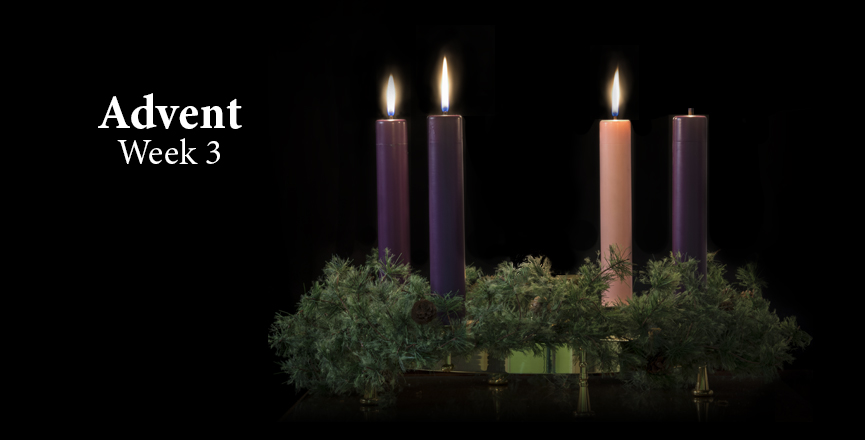
Image result for advent 3


            Waiting ... for Christmas break; students get time away from class and some have jobs that allow time off from December 25th to New Year’s Day; .  
            Waiting ... for Christmas morning, gathering round the lighted tree as presents are excitedly opened and a special meal is shared with the family.
            Waiting ... for the stroke of midnight when we get to shout “Happy New Year.”  
So much of this season is built around waiting.
 This is unlike any other time of the year.  We stretch out our celebration of Christmas.  Some grumble that decorations go up too early, or complain that the holiday has become too commercialized.  In truth though, a lot of people feel a unique kind of specialness.  We hope that during the holiday season, people will act a little bit nicer.  People in financial distress call churches and charities hoping the generosity will be greater because it’s Christmas.
But, to me it feels weird to say we are awaiting the arrival of Jesus because he came already - 2000 years ago.  Thus our Advent scripture readings are infused with double meaning.  Our ancestors in faith awaited the Messiah; we await the Second Coming of the Messiah.  
As we do, we listen to the sermon of John the Baptist preached on the bank of the Jordan River in 30 AD.  What does the arrival of Jesus - his first coming - mean for us now  - in the living of our lives today?  Why is it important that Jesus was born?
“The word of God came to John, son of Zechariah, in the wilderness.  He went into all the region around the Jordan proclaiming a baptism of the forgiveness of sins” (Luke 3:2b-3).  John preached to everyone who came - the wealthy, the poor, the sophisticated urbanites and rough-around-the-edges shepherds and fishermen; his word was for Jews and gentiles.  To all he said, “Bear fruit worthy of repentance.” 
The Bearing of fruit metaphor was used both by John the Baptist and by Jesus as a way of describing what is produced in the life of a believer.  Jesus said in the Sermon on the Mount, “Beware of false prophets.  ... You will know them by their fruits. ... Every good tree bears good fruit and every bad tree bears bad fruit” (Matthew 7:15-18).  Jesus later says, “God removes every branch in me that bears no fruit” (John 15:1).
Fruit is a sign of growth.  When we lead others, those outside the faith, to meet Jesus, we are bearing fruit.  When we help new believers grow in their understanding of God, we bear fruit.  When we guide believers into new opportunities for mission and good works, bear fruit. When we meet people in great need and help them out of our own abundance, we bear fruit.  When, through study and prayer, we deepen our relationship with God, we bear fruit.  When we encourage people who are hurting, and when we walk with them through their trials, we bear fruit and grow as disciples.
Jesus’ very drastic statement is that when we do not bear fruit, our connection with him is severed.  God removes every branch that bears no fruit.  There’s no such thing as casual faith.  We grow as disciples or our faith is dead.  “Bear fruit worthy of repentance,” John preached.  Repentance, of course, is making that full turn away from the temptations and cultural trappings of the world around us and turning fully to God.  Repentance is the most radical change one can experience.   “Every tree that does not bear good fruit,” John preaches, “is cut down and thrown into the fire” (3:9).
Anyone who takes the word of God seriously would, at this point in the story, come to two conclusions.  First, being thrown into the fire is judgment.  It is the state of being cut-off from God.  Failure to bear fruit, failure to live an active faith, is equal to calling judgment down on ourselves, and we do not want that.  We do not want to face life without God, much less face eternity after death without God.  The second conclusion is, we have to ask how do we avoid this judgment?  That’s what the crowds hearing John wanted to know. 
In 3:4, Luke describes who John is and what John is doing, Luke quotes the prophet Isaiah, “Prepare the way of the Lord, make straight his paths.”  John is the one preparing the way and Jesus is the Lord.  Because Jesus has come, everything has changed.  That’s why John issues the call for repentance, and that call involves changing is what our lives are about.  
What must we do?  The crowds asked that question and John offered a ready, practical response.  “Whoever has two coats, share with any who has none.  Whoever has food, share with anyone who is hungry” (3:11).   Judgment does not have to come for us.  It’s coming, and will be harsher than we can imagine and will be final.  God’s judgment is to be feared because God is holy and will not tolerate sin and every one of sins.  But, John offers a lifeline.  Share with each other so that no one is freezing or starving or crippled by poverty.
“What should we do?”  Tax collectors asked.  They collected taxes imposed by the Roman empire.  Roman soldiers would force peasants to pay whatever the tax collectors demanded.  Most tax collectors demanded higher amounts than Rome required, and got rich pocketing the difference.  They were thieves. 
What should we do?  John doesn’t tell them to quit the tax collecting business.  He says, “Collect no more than the amount prescribed.” In other words, work ethically.  What does that look like in your job?  Where you work, away from the church, in the world - that’s where your discipleship is on display.  It doesn’t mean you’re always talking about Jesus.  Sometimes we do.  At other times, you do your secular work to the very best of your ability and you do it honestly.  When we live in integrity, we bear fruit.  When we treat people around us with kindness, we bear fruit worthy of repentance.
“What should we do?”  Soldiers asked John.  The soldiers were charged with maintaining order.  They possessed unchecked power.  They could bully the people and take what they wanted, and they did.  What should we do asked these soldiers who felt convicted by John’s words.  
“Do not extort money by threats,” he answered.  “Be satisfied by your wages.”  He didn’t tell them to quit the military.  John did not impose pacifism as a rule for God-worshipers.  In fact, his answer implies they would go right on being soldiers, work that is by nature violent. But, if we take the bullying, the threats, and the intimidation of common folk out of their work, then soldiers are responsible protectors who can be respected and even admired.  When we use whatever power we possess for good, to help people, to contribute to people’s flourishing, we bear fruit.  Sharing, acting ethically and honestly, and protecting and helping are all ways we can, in our lives, bear fruit worthy of repentance.  We choose to live this way because Jesus has come. 
His coming, His Advent, is a sign that God’s judgment is coming.  We take that seriously and know that on Judgment Day, if we have to stand on our own merit, we’ll be found lacking.  So, we repent.  We live to worship God and help others.  We acknowledge God as Lord throughout our lives, not allowing any aspect of life to be secular, apart from God’s rule.  And then, we trust God.
John knew that Jesus, and not he, was the Savior and Lord.  “I am not worthy to untie his sandals” he says (3:16).  He baptizes with the Holy Spirit.  He will judge, collecting the good fruit and bringing it into God’s house, and casting the bad out to be burned, cut off from God.  We can’t control that harvest.  We can’t determine if we will be saved or judged.  God judges and we are at God’s mercy.
So John, offers something we can all do in our lives, right now as we wait.  Because Jesus has come, we can share, be honest, be ethical, be kind, and be compassionate.  With the help of the Holy Spirit, we can live as people of the Kingdom of God even while we live in the world, fallen as it is.  And John promises the help of the Holy Spirit because Jesus baptizes us in the Spirit and Jesus has come.
As we wait for His second coming, we live in the reality of His first coming.  Our lives are different than the lives of non-believers because the Spirit is in us.  The world needs us to be different just as the world needed things to be different when Jesus was born.  
So, find someone with whom you can share.  Find a hurting person in need of encouragement, or a lonely friend in need of compassion.  When your peers cut corners on the job, express your repentance by working ethically.  And the when the opportunity is there, tell someone about why Jesus is your Lord.  Invite someone to come to worship with you.  This is the Advent fruit we have to share.  And people are hungry for it.
AMEN


Monday, December 18, 2017

We Need Christmas (John 16:16-24)

Third Sunday of Advent: Joy
Sunday, December 17, 2017


The December issue of National Geographic arrived a few weeks ago.  The cover is the very famous work entitled “Head of Chris” painted by Rembrandt in the 1640’s.  Ah, we see what Geographic is doing.  It’s December, Christmas is coming, this is a magazine committed to popularizing culture, nature, and scientific discovery, and so, why not apply scientific sensibility to a world-wide cultural phenomenon, the religion behind Christmas. Why not take a scrutinizing look at the people who follow and worship Jesus, the man the baby in the manger grew up to become?
The caption on the cover confirms the intent. It says “The Real Jesus: What Archaeology Reveals about His Life.”  Do you catch all the implications within this simple sentence?  We just sang, “Joy to the world, the Lord has come.”  We think that the baby Jesus grows up to become the “Lord Jesus.”  We proclaim it, we sing it, we pray it, and we insist it is the truth of all truths.  But is this a legend, a story first century Jews made up as a part of a series of ecstatic prayer experiences?  Is the Lord Jesus not actually the real Jesus?  See the questions raised by that caption under Rembrandt’s painting on the cover of National Geographic?
With the question before us, where do we go? Where do we turn to find out the truth about “the real Jesus?” Do we turn to the internet?  You can sit and down type it into Google.  In case you wondered, Google took less than half a second to produce 33 million hits in response to this question.  Good luck sorting through all those sites, all of them based on someone’s agenda.  Where else could we go for help with this?  You might call Heather or me or Beth, Phil, or Angel for that matter.  Or Hong or Dina or Greg Meyers.  We all have seminary degrees.  Or, if you’re feeling intrepid, you may skip the professionally trained clergy and go straight to the Bible yourself.  Anyone who is literate can read the divinely inspired accounts and form their own understanding of “the real Jesus.”
National Geographic goes in a different direction.  Again, the words on the cover: “The Real Jesus: What Archaeology Reveals about His Life.” Archaeology is the study of human history and prehistory through the excavation of sites and the analysis of artifacts and other physical remains.”[i] It is a science, one that works hand-in-hand with its sister discipline, history, which is also practiced as an emotionally detached academic discipline.  National Geographic thinks that the science of archaeology will give us more fact-based truth about the historical figure of Jesus than anything we might find in biased accounts like Matthew, Mark, Luke, and John, written from a faith perspective.  When a historian or archaeologist declares that faith and miracles and the supernatural are all fantasy and the only things that are real are the facts science can establish, it has the potential to suck the joy right out of Christianity for me.
I love National Geographic, a magazine that comes from a worldview that stands on scientific discovery and proof as the only standard for what is real.  The author of “The Real Jesus” article, Kristin Romey, appreciates what science can say, and also appreciates the limits on scientific inquiry.  There is no way the science of historical research can prove or disprove that an angel spoke to Mary and that Mary was a virgin when she became pregnant with Jesus.  National Geographic tends to default to the view that the virgin birth would have been legend, not something that actually happened.  Science has no category for something that occurs outside of scientifically established natural laws. 
When archaeology and history are practiced as sciences, what they can do is give as accurate a picture as possible about what human life and human society was like in the past – in this case the late first century BC and the first half of the first century A.D.  The article in National Geographic does a thorough job of showing how scientists have over and over verified that much of what we find in the four gospels is historically solid.  The cities reported by Matthew, Mark, Luke, and John, were where those gospel-writers said they were.  Kristen Romey shows that based on what history can prove, Matthew and his three Gospel-writing peers got the facts right.  First century Israel was mostly likely the way they described it when Jesus was born, when he lived, and was crucified.    
If you’re tempted to say, “Oh, I didn’t need science to tell me that,” allow me to push back just a bit.   As followers of Jesus, we should all be enthusiastic supporters of S.T.E.A.M – science, technology, engineering, arts, and math.  No, we don’t need science for salvation.  However, Jesus commands us to love the Lord with all our mind.  Our church has many members who stretch their minds to the limit in their work, scientific research.  As a worshiping community, we need to foster an environment in which our students are encouraged to excel in science whether it is elementary school or a PhD program or anywhere in between.  We need to bless our members who are scientists and also are Jesus’ disciples.  Their work can be an offering to God and they should glorify Him by committing to excellence in their work. 
Science matters because there are things that can be proved.  For instance, if an ossuary, a bone box, was discovered, and it was proven to contain the bones of Jesus of Nazareth, our faith would be shattered.  We stand on the belief – a belief we insist is incontrovertible fact – that Jesus rose from the grave.  So, if we found what we know to be his grave, it better empty.  Or, our faith crumples. 
However, there are realities for which science cannot account.  Researchers can say what life was like in first century Nazareth, but they can’t prove or disprove that Jesus performed miracles there.  They can’t determine whether or not an angels appeared to shepherds in Bethlehem or spoke in Joseph’s dreams.  The author of the National Geographic piece was very fair on this point.  She traveled all over Israel – Jerusalem, Bethlehem, Capernaum.  She met Christ followers from every country you can imagine.  From all over the globe, people traveled to worship Jesus on the ground where he actually walked.
At the end of her article Kristin Romey writes, “To sincere believers, the scholars’ quest for the historical, non-supernatural Jesus is of little consequence.  That quest will be endless, full of shifting theories, unanswerable questions [and] irreconcilable facts.  But for true believers, their faith in the life, death, and Resurrection of the son of God will be evidence enough” (p.68).  I appreciate her recognition of the both/and quality of the Jesus story.  There’s the Jesus who existed in history, and the Jesus who transcends and fulfills history.  They are one and the same and this Jesus is the subject of our worship. 
Christmas time sees us entering into a special season of worship.  The scientific study of Jesus gives us a framework to talk about the story in a post-enlightenment age.  But we need miracles because we need more than just what modern man’s technology can provide.  We don’t just need cures; we need hope.  We don’t just need life to be made easier; we need life to matter.  We don’t just need a few days off to rest and visit family; we need worship that reminds us we are transformed, a people made new in Christ.  The way Christmas has come to a place of importance for my own family helps me see why it is so important.

            Our kids sit around the computer with my wife Candy, and together, they play a simulation that includes a graphic with green and red wrapped presents, an old-time village decorated in Christmas lights, Christmas-related games, and a repeating track of delightful Christmas music in the background.  Beginning on December 1 and going all the way to the 25th, there is something new every day as they click on the globe icon.  Around the time supper is ending and the time for homework is nearing, I say, “Kids, it’s time for the globe,” and they assemble on the sofa and get the computer ready.  Every year.
            In darkness of the early morning, at this time, as we are rousing, getting breakfast, school lunches made, getting ready to catch the bus that comes at 7:05, I tell one of the kids, “plug the Christmas tree lights in.”
            In this season, when we are driving home from a basketball practice or a gymnastics class or Wednesday night youth group, from the back seat I hear, “Dad, can we drive through the neighborhood and look at the lights?”  I say, “Yes.”  We do this several times, pause to see how our neighbors have decorated to celebrate the season.  Every year.
            The pilgrimage to the theater to see the Nutcracker.  Decorating homemade cookies, little trees, stars, and Santa Claus’s.  I need this.
            Four or Five years ago, I had a nasty head cold that ran all through December.  I grumbled and growled.  I wanted nothing to do with Christmas songs or lights on houses or drives through our neighborhood.  Sometime around December 27th or 28th, my wife said, “You were a real grouch this Christmas.”  She was right.  That has stuck with me.  I don’t want to be that.  I need the joy of the season both from our faith and from our cultural ways of celebrating and living that faith.  I need that joy.
            I think most people do.  We spend Advent anticipating his birth as we relive the story, anticipating new things he will do in our lives in the coming year, and waiting with anxious patience for his return at the fulfillment of history, when history ends and God’s kingdom is fully ushered in.  John captures this spirit of longing, waiting, and uncertain in chapter 16 of his gospel.
            There, Jesus is preparing the disciples for his coming crucifixion and then resurrection and then ascension.  They don’t understand much of what he says, but they have the words, and after he is raised from death, and after they see him ascend in clouds and the Holy Spirit fills each one of them, they remember and understand in a new light. 
            “You will have pain,” he tells them.  “But your pain will turn into joy.”  Jesus’ words recall the prophet Isaiah who says, “The Lord gives beauty for ashes, gladness in place of grief” (61:3, my paraphrase).   This is what God does.  Our sin produces pain and death, and draws us away from God.  God, through the death and resurrection of Christ, defeats death, removes our sin, and gives us blessing.  Our pain turns to joy.
            Jesus continues in John 16:22, “You have pain now; but I will see you again, and your hearts will rejoice, and no one will take your joy from you.” Grab a hold of this promise he made to 12.  Claim it for yourself.  These words are in the Bible, handed down to the church, to us, for us.  God, in the risen Christ, in the present Holy Spirit, takes your pain, give you joy, and protects it, so that you have joy unending, joy that cannot be ripped from you.
            And finally Jesus says, “Ask and you will receive; I have said these things my joy may be in you and your joy may be complete” (16:24; 15:11).
            Based on the assessment of all the available evidence, researchers have determined that Luke, John, and the other gospel writers give an accurate picture of first century Israel.  In terms of verified reporting, John can be trusted.  We know our own stories, how much we need the joy that is promised in the Bible, in the story of Jesus.  That Jesus himself said we can ask and God will give divine, unending, life-changing joy.  Why don’t we ask him to do that?
            I don’t know the specific challenges that block your path in life right now, but I suggest, we end our time with prayer.  Ask God to be with you as we sit together in the Advent season and you face whatever it is you face in your life.  Ask God to sit with you.  And, ask God to fill your heart with Jesus’ love, so that you can know without a doubt that His joy is in you, and your joy is complete.  This is something beyond explanation, something only God can give.  And he wants to.  So ask God in right now.
AMEN


[i] https://www.google.com/search?rlz=1C1CHBF_enUS749US749&ei=huozWoH5O-GR_QaCjbqgCQ&q=archaeology+definition&oq=archaeology+d&gs_l=psy-ab.1.0.0j0i20i264k1j0l8.2888.3881.0.5059.4.4.0.0.0.0.83.311.4.4.0....0...1.1.64.psy-ab..0.4.307...0i10k1j0i67k1j0i131i20i264k1j0i131k1.0.4uBrsPNZd9Q

Tuesday, December 13, 2016

Joy in the Waiting (James 5:7-11)

3rd Sunday of Advent, December 11, 2016

          Work hard for God by sharing God’s love.  Use your resources to feed people who are hungry.  Through invitation and friendship and conversation, help people who have no knowledge of God come to know God through faith in Jesus.  Encourage Christians, friends who have gone through pain, by standing with them and helping them.  Help.  Provide.  Evangelize.  Work.

          On the other hand …

          Sit in silent, blissful stillness as blessings from God wash over you.  In the exultant triumph of music, experience the glory of God.  See God’s goodness in friends who bring happiness to you in the things they do for you.  Bask in God’s majesty as you meet God in creation, in nature.  Marvel.  Relate.  Listen.  Be blessed.

          Is the faith dynamic clear?  As we live in relation to God through Jesus, we live in a dynamic of reaching and receiving.  We reach for the Kingdom of God when we work for justice, when tell others about Jesus, and when we work to build up the church community and help the family of God be a community of love and welcome.  All of this takes proactive effort on our parts.  As an individual believer, being a Christ-follower involves complete commitment.
          At the same time, we know that the greatest blessings of life are those God gives when we have not earned them and sometimes when we least expect them.  This is very hard, because we are a hard-working people who like to think that we get by on our own capabilities.  We have to resist the urge to claim independence.  We are dependent.  We depend on God’s grace for joy, for spiritual and emotional fulfillment, and for eternal life. 
          We reach and we receive in relation to God.  When we think of who we are as a body of believers and as individuals, we understand the necessity of both.  We do not neglect the work of discipleship telling ourselves “God will take care of it.”  We go to work.  We study for the exam.  We pay our bills.  We raise our families.  We contribute to society.  We build up the church.  Through spiritual disciplines we grow and mature as disciples.
          At the same time, we do not count on our own efforts.  We work hard in all things, all the while knowing our best blessings come as gifts God gives.  We neither neglect work, nor do we deceive ourselves into depending on our own efforts.  We live in a reach-receive dynamic.  It is a beautiful way to live as we enter the story of the birth of Jesus.  In entering the story and reliving his birth we see that our lives don’t make sense apart from Jesus.

          Our family does not go to the mall or toy stores – never, ever.  But somethings cannot be avoided indefinitely.  My 8th grade son I__ sings in his school choir and we want to support him.  So, when they do their annual holiday concert at Barnes and Noble bookstore, our family goes. 
          It seems like every time I am in there, Barnes and Noble has sacrificed space that used to be used for book shelves.  In that space, they sell other things, like toys.  I cannot imagine Toy ‘R Us selling more stuff for kids than what they had in the Barnes and Noble we recently visited for the choir concert.  It was plenty for my 2nd grader and 4th grader to look at and wonder at as they waited for I__’s concert to start and waited even more longingly for Christmas morning to arrive.
          “Daddy, come look at this!”
          “Oh Dad, you have to see this!”
          I thought maybe the two of them were going to rend me apart, rip me into two pieces.  And maybe they wouldn’t notice as long as each one had one of my hands they could drag to football card collector’s set or the American girl doll or the Lego this or the Lego Friends that.  It was fun to watch them, but it was also clear that my children, at that moment, were not interested in receiving blessings on Christmas morning.  They were reaching for what they wanted. 
          And it is OK.  It is OK that in that moment they expelled the holiday energy bubbling up inside because they know they have a mom and dad who love them and who want to give them good things.  On Christmas morning, they will be happy with what they receive.  They won’t dwell on the 55 things on their lists that aren’t under the tree.  They’ll celebrate the goodness they receive.  (I hope).  The reaching and the receiving are both part of this season.  So is the waiting. 
          Three stages of waiting have an accent that is unique to the Christmas season.  First we wait for the birth of Christ.  It’s tempting to say, “No, Jesus was born 2000 years ago.”  We wait for his birth in the sense that a part of our worship is to enter the story of God and human beings, and a key point in the story is the miraculous birth to Virgin Mary.  We know that her premarital pregnancy caused a scandal.  We know Joseph was a faithful and good and stayed with her in spite of the scandal. We know the Roman census forced them to make the ill-advised journey to the Joseph’s family town of Bethlehem.  We know they make it.  We know that so many people had to do this because of an imperial overlord unconcerned about how his edicts inconvenienced an entire populace and so there was no place to stay.  We know that this led to the Savior being born in a barn, a stable. 
          Knowing all of it, we enter the story.  Waiting for the birth is as much a part of the waiting of Christmas as is waiting for Santa Claus and presents under the tree.  We can’t hurry it along.  We put up our tree, we hang our stockings, we decorate our homes in lights, but no matter what we do, December 25 does not get here until December 25.  And Jesus is not born until we arrive in Bethlehem.  Ask Heather.  The baby comes when it is time and not before.  For all our reaching, the blessing is one we receive. 
          There’s another stage of waiting.  From Halloween to Thanksgiving to Christmas to New Year – we call this the holiday season.  But there’s a waiting that is beyond this, a waiting that hits us any time of the year throughout our lives.  We wait for God to act. 
          You’re a Christian, certain that the only way to have a meaningful life is to live in relation to Jesus as his follower.  And someone you care about has not committed to Christ.  Your dear friend is ambivalent about faith.  You’ve prayed.  You’ve witnessed to your friend.  Now, you’re waiting for God to reveal God’s very self to your friend in such a dramatic that like the Apostle Paul on the road to Damascus, your friend cannot resist God any more.  You’ve done all you can, but you know you have no control over God or your friend’s responses.  So you wait hoping your friend will turn to Christ.
          You are at a decision point.  What comes next in your life?  You’ve made a list of pros and cons if you choose ‘A,’ and a list of pros and cons if you choose ‘B.’  You have researched.  You have thought it through and discussed it with close friends.  They are praying too.  But you don’t want to move until God shows you the way. So now you’re waiting for God to speak. 
          We could list numerous other ways we wait for God to act.  The young person trying to discern God’s call waits.  The horrible powerlessness in the room aptly named, the waiting room, where we hope the doctor will tell us our dad is going to make it, God has healed him.  Waiting for the birth of Jesus reminds of our lives spent waiting for God to act.
          Also we think of the ultimate waiting: we wait upon the return of Christ, which is promised in the Bible.  He who defeated death in his resurrection then ascended to the right hand of the father.  He will return.  We don’t know when, so we wait.  The New Testament story reveals that his return means wars will end forever.  Evil and death will be permanently defeated.  All who have died in Christ will rise as Jesus rose.  And we will live together in relationships of love in the Kingdom of God forever. 
          The New Testament book of James says, “Be patient beloved, until the coming of the Lord” (5:7).  The final judgment, the resurrection of all people, and the end of days is what is meant by the phrase ‘the coming of the Lord.’  James counsels patience because we have to live faithfully until Jesus returns. 
How are do maintain joy as we wait?
The word ‘patient’ connotes endurance.  The church James wrote to was under persecution.  They were minority group victimized by prejudice and sometimes terrorized by government officials.  The church told by James to be endure was at times afraid for its very survival.  In this context, they were to go beyond just surviving and actually called to thrive as witnesses that drew the world to God through knowledge of Jesus.  James and other early church leaders taught the church to share the joy of Christ with a lost and hurting world.  That divine mandate has passed to us
Thus in verse 9, he addresses the church members as ‘beloved.’  They are family.  They are not a group of like-minded individuals.  They are not an institution or a non-profit agency.  They are brothers and sisters in Christ.  Beloved. 
Think of our church family that way.  The United State government has classifications for us – non-profit; religious organization.  People on the street have notions of what goes on in here.  People in other religions will describe us in one way or another.  We know that we are a family, sisters and brothers linked in the heart because of Jesus.  When James writes “beloved” in verse 9, he’s writing to us.
“Do not grumble against each other.” 
Reaching for the Kingdom of God leads us to be too self-reliant.  Those who do more or accomplish more may have more recognition within the community of faith.  Maybe they appear more Christian or one might say they more advanced as Christ followers.  Retreat to a posture where we only wait to receive can lead to spiritual sloth where we never grow.  The waiting to receive might produce a person who makes a commitment to Jesus but after that never lives a Christ follower.  An outside observer would never know that person has anything to do with Jesus. 
We reach and we receive – the life of faith is both.  Waiting for the birth of the promised one; waiting for God to act in our lives; waiting for the final resurrection; throughout our waiting, we live actively, and we live gratefully.  We reach for the Kingdom while receiving blessings from God.  And we do this as a community of peace.
Much of James echoes the words of Jesus in the Sermon on the Mount and in other places.  In chapter 2, verse 8, James repeats Jesus’ royal law – “love your neighbor as yourself.”  Thus two instructions from James color our living as we wait: be patient and do not grumble against one another.  Waiting purposefully, as people who grow in our faith, and gratefully, as people who receive blessings, and waiting peacefully, we come to a wonderful discovery.  Joy is in the waiting.
We will end our worship singing these word.  “Angels we have heard on high, sweetly singing o’er the plains: and the mountains in reply, echoing their joyous strains.  Gloria, Gloria, Gloria, in excelsis Deo!” 
Earlier we sang “Joy to the world.”  We’ve been singing these songs for three weeks now and will continue through the end of the year.  As a family together – a family of peace and love, not bickering and resentment – we wait, together.  The joy reaches its height in the manger, but it has already come. 
“Daddy, come and see this.”  That longing joy is there.
“My friend, come with me to church this weekend.  There are many nice people ready to welcome you and love you as you are.”  That welcoming joy is here and is growing.
With the eyes of our hearts fixed on God, the motion of present joy, coming joy, growing joy need not be unsettling.  The motion can actually be reassuring that God is present and at work among us.
The Christmas season has every emotion.  Every one.  I believe that when we are in Christ no matter what else we have, we can also have joy.  Reach for it.  Receive it.  Wait for it.  And do all of this in the embrace of the family of God, the body of Christ, the church.  In Christ, God beckons you to come to His loving arms.  Come to him today.
AMEN 

Thursday, December 24, 2015

God Trending (Isaiah 12:1-6)

God Trending (Isaiah 12:1-6; Matthew 3:1-3)


          This year when the radio station switched to all-Christmas music, I was ready.  I was determined to enjoy the season and to not complain.  We have driven through neighborhoods at night to see how people light up their homes.  Our tree was up and decorated early. Here at church, we had the church dinner with tables decorated. 
I love the fun traditions of Christmas and our family has many of them.  It really helps us feel the spirit in the season.  I celebrate that. 
In church, when we worship, we have a specific calling that is related to the good feelings of Christmas but is more purposeful because our worship is a part of our life in Christ.  Our responsibility in worship is to enter the story of Jesus which begins in the Bible but continues in our lives.  Sentiment is beautiful, but it is something we can put away along with our decorations on January 2. 
We can’t do that with the story of Jesus.  When we realize that it really happened, it changes everything. 
One of the things I find most effective in theological writing is actually a simple observation.  Theologians have an entire vocabulary of words that only make sense in theological writing.  But I have been deeply affected by a basic truth given to me in reading works of theology.  God has done something.  Christmas is news of God’s action.  How does this news hit us?
Maybe it doesn’t hit us at all because it doesn’t feel like news at all.  A veteran preacher has extremely thick file folders on Luke chapters 1 & 2 and Matthew 1 & 2.  We read those chapters in church every year at this time.  This story is news?  We hear these verses, and we sigh.  Been there, done that
Compare the news of God with what’s currently in the news.  If you go on Twitter, certain topics are trending.  Type in #starwars or #republicandebates or #Syrianrefugeecrisis.  Everyone is talking and tweeting about these things.  Instagram has photos, Facebook has posts, and cnn.com provides pithy articles with video. 
One of the radio shows I listen to has a segment called “What everyone’s talking about.” Well, is everyone talking about the thing God has done?  God is not trending on twitter.  If God acted, Facebook would blow up from all the posts.  Facebook has not blown up.
          I actually went to my Twitter page and typed in a search: #GodsNews.  There were several hits.  It’s not trending, but several Christian tweeters have used this hashtag.  But, you know, it wouldn’t matter if there 10 million people tweeting about Jesus or just 10.  God’s importance is not tied to the number of Twitter mentions God gets.
          We follow him because he is Lord.  He doesn’t stop being Lord if his Clout score decreases or his popularity wanes.  He doesn’t get a bump in his divinity and sovereignty if he gets more Twitter followers.  He is Lord because he couldn’t be anything else.  The three bits of evidence of his Lordship are creation, the resurrection, and the personal relationships his followers have with him.
We belong to him and we have a story to tell, an alternate narrative to the ones that get tweeted so often.  God is not the most popular force of our time.  Nevertheless, we know God has done something.  We have news to share.  God has acted. 

          What has God done?  God, in Jesus Christ, God-in-the-flesh, has established the eternal Kingdom.  In Jesus’ death, in which he shared with us the end result of sin, and in Jesus’ resurrection, in which he defeated death, God has begun the work of redeeming the world.  God’s work will come to a conclusion when Jesus returns, all are judged, and the world is made new.  Heaven and Earth will come together, and it will be good as all things created by God are good.
          In this Kingdom, there is no sin, no rebellion, and no death.  Imagine a country like that.
History shows that every human government has had to guard against rebellion.  The malcontents, the disposed, those who feel powerless try to overthrow the powers that be.  Every society has rebels and lawbreakers.  Human governments have to punish criminals and turn back revolutionaries.  And all human governments eventually crumble because all are designed by and run by sinful human beings. 
          God is doing something different, establishing a Kingdom where there is no rebellion and no crime.  There is no sin, no evil, no disease, and no death.  It is a concept beyond my grasp.  I cannot picture it.  The birth of Jesus is the first step in this becoming reality.  The final chapter comes when Jesus returns.
          We live between Jesus’ resurrection and his second coming.  When he returns, we join him in resurrection.
In our time, individuals can opt to follow the Lord or go their own way.  To follow Jesus is to trade any form of government we can conceive including our own constitutional democracy for a Kingdom.  Of course even as we are fully submitted to Jesus as Lord we still continue to participate in our culture and in our country’s life.  We participate as a good citizens, committed to fighting injustice as we help the people in our community flourish.  We are engaged but as people who belong somewhere else – in God’s Kingdom.  We exchange the notion of independence for rule – we would be ruled by God. 
Why would anyone make such a trade off?  Because, in throwing our lot in with Jesus, in accepting his cross and his forgiveness, we trade sin and all its consequences for new birth.  We are new creations.  We exchange bondage – we are slaves to sin – for freedom in Christ.  We trade pain and death for joyful, glorified eternal life.  When we assert definitively that God has done something, this is what God has done!
In the fourth verse of the hymn “Come Thou Long Expected Jesus,” we sang “born thy people to deliver; born a child and yet a king.  Born to reign in us forever.  Now, thy gracious Kingdom bring.”  Did the slaves under Pharaoh rejoice that he reigned over them?  I think not.  Did citizens of Germany sing praise songs for Hitler?  Maybe, but only out of fear.  No one praised Hitler out of love or true loyalty.  Human history has shown that kings often rule by keeping their people under heel.  Even good kings eventually become tyrants. Yet, the reign of Jesus provokes rejoicing.
Another Christmas hymn, one we have sung in different versions the past two weeks makes the same point.  “Joy to the world!  The Lord is come; let earth receive her king.”  I don’t think the people of North Korea, if they could express thoughts without fear of punishment, would joyfully sing of their lives under the reign of Kim Jung Un or his father or grandfather before him.  In the hymn, “Joy to the World,” with our song we rejoice that we are subjects in a monarchy, the Kingdom of King Jesus. 
This is news to those who don’t know him and increasingly, even in our country, people grow up with no knowledge of the Biblical account of Jesus.  The prophet Isaiah writes “Give thanks to the Lord, call on his name; make known his deeds among the nations; proclaim that his name is exalted” (12:4).  God’s action in Jesus compels us to tell whomever will listen about God and about the significance and relevance of Jesus. 
Jesus brings hope of rescue from death.  Jesus offer hope of a life of joy and meaning to all who follow him.  We tell the news of God in such a way that people see not just another religion that can be reduced to doctrine that can be accepted, rejected, or ignored.  We tell about God so that it is evident that absolute hope for the fullness of blessing and rich joy will come to anyone who hears our report and respond by putting faith in Jesus.  We make his deeds known.
Matthew picks up on the prophetic word by describing the prophet, John the Baptist, who set the conditions into which Jesus would burst upon the scene.  Of John Matthew says, he is the one to “Prepare the way of the Lord” (3:3).  In his preaching and baptizing, John made the worshipping communities of 1st century Israel ready for the arrival of the Messiah.  We, by announcing the news, help those who hear us get ready to meet God.  We help people move from the thought of ‘Christianity as one religion among many,’ to ‘wow, God has done something and because of it, I can know Him.’
We aren’t prophets in the sense of the Biblical prophets like Samuel and Nathan, Isaiah and John the Baptist.  But we are news-announcers.  Is “God trending,” because of our witness, our testimony?  Maybe not.
However, we can hold up our relationship with God and the Biblical story of God’s action in Jesus Christ.  We can be a friend and in the context of friendship point to God’s action in Christ.  We can do this.  And we can hold up our own individual relationships with God in Christ as evidence.  Through this movement of sharing news in casual relationships, we invite those who do not know Jesus at all to enter the story. 
This is contingent on one thing – the main thing for us this morning.  I began by declaring that while sentiment is lovely, as worshipers our responsibility is to announce that God has done something in Jesus.  In Jesus, God has come in human flesh for the salvation of the world.  Next, I said this thing that God has done is initiate the establishment of His eternal Kingdom.  Then, I said that this truly is news for those who do not know Jesus at all.  And we even meet people like this in our supposedly Christian culture because our culture is quickly becoming post-Christian.
The final and main point of this news is the awakening it triggers in those of us who do know Jesus, but have not fully understood him.  We can only point to our own relationship with God in Christ as an example of the effect of what God has done if that relationship is real and makes a difference. 
So, is it?  Is my relationship with God a real thing, or a fantasy I have concocted?  Does the action of God make a difference in your life?  Or is Christianity just a religion you or I choose to practice?
Last Christmas, I held everything in close – my emotions, my love, my joy.  I did not share it with my church family.  I did not enter the happiness of the season with my wife or kids.  My excuse was that I was sick. I had a rotten cold that carried on from mid-December through the New Year.  I wallowed in phlegm and discomfort and absolutely refused to embrace Christmas cheer.
My wife was not happy with me and in early January she told me flatly, “You were a real grump this Christmas.”  Ouch!  I never wanted to hear that again.  From the time she said that, I have been determined to be happy this year.  Along the way, I discovered something important.
          Maintaining a sweet spirit at Christmas so that people around you, the people you love, will have a good time – that’s important and noble.  There is though something much bigger.  When we pay attention to who we become when we receive life in Christ, the joy cannot be contained.  It is the most important aspect of our message when we share the news about what God has done. 
          When we know God, we want him to be our king.  When we know God we want Him in the center of our every thought and experience.  He is trending in our hearts.  When we know God the joy spills out contagiously.  People around us may become Christians, they may not.  But they will be invited into our joy in a way that is unmistakable. 
          Isaiah could make God known and John the Baptist could prepare the way because each knew God.  They weren’t sharing theories or doctrines.  They were speaking out of their experiences of relationship with God.  Because of what God has done, you and I can enjoy just as powerful a relationship with God as these notable individuals of history.
          So, enjoy Christmas cheer.  Invite friends out for coffee.  In the course of light, casual conversation, talk about what it means to follow Jesus and love Jesus.  Find ways to share why He is so important in your life.
Invite friends to our Christmas Eve service. 
But before doing any of that, sing these Christmas songs.  Worship with your brothers and sisters in your church family.  Bring your struggles to the cross – the small things and the big things.  Be fully present to God and fully open.  Do this so that when it comes time to talk about God and all that God means to us, we will have something to say.
AMEN