Total Pageviews

Showing posts with label Sermon on the Mount. Show all posts

Monday, June 15, 2020

Turn the Other Cheek - Matthew 5:38-39


Turn the Other Cheek – Matthew 5:33-42 | Reading Acts


Sunday, June 14, 2020

          I had a moment when I had to decide what mattered more, my position on an issue, or my love for my friend.  I believed anyone in the United States illegally was a criminal, and should be deported.  I was unflinching in my resolve.  Then, I found out that one of my closest friends was in America illegally.   Fernando was my brother in Christ.  Truly seeing him my attitude toward the immigration changed.  I share this not to sway your view but rather to invite you to pause.  Regarding any issue, see the human beings involved, God’s image bearers. 
          I had prejudicial LGBTQ-related opinions, but then became close friends with gay people.  I have seen the fruit of the spirit produced in the lives of gay Christians.  I still hold what I think is the Biblical view in this conversation, but I tremble as I hold that view, and I appreciate the tension.  I am as much a sinner in need of love as anyone.  Jesus came to love me and calls me to love people – those who agree with me, those who despise me, those who hold me in contempt, and even those who would attack me.
          Matthew 5:39 is among the most challenging of Jesus’ teachings.  The life of a disciple is more demanding that other paths we might choose.[i] Jesus is not looking for believers, converts, or admirers.  He doesn’t have a logbook where he charts church attendance, hours spent reading the Bible, and how much Christian music we listen to.  Jesus calls disciples.  If you have any interest in the way of Jesus, listen.  Pay attention.  This demanding life?  You’re called to it.
          “If anyone strikes you on the right cheek, turn the other also” (Matthew 5:39a).  Much ink has been spilled by theologians and pastors trying to wriggle out of the full implications of Jesus’ word.  He couldn’t have really meant let people punch you.  Could he?  There’s has to be some deeper explanation that frees me up from actually applying this to my life. 
You don’t think Jesus meant it?  Read any of the Gospel accounts of him being arrested.  He was punched.  He had thorn hammered into his head.  He was flogged and his hands were pierced.  When he was arrested, Peter whipped out a sword and chopped the ear off one of the assailants.  Peter did what you or I would do.  He hit back.  Jesus’ harshest rebuke that night came against Peter as Peter defended him.  He healed the man’s ear and said to Peter, “Do you think I cannot appeal to my father, and he will at once send me more than twelve legions of angels” (Matt. 26:53; Jn 18:10-11)?  But he didn’t lift that prayer and no sword-wielding angels came.  Jesus turned the other cheek.  He talked the talk in the Sermon on the Mount and walked the walk in the Garden of Gethsemane. 
He expects us to follow his lead, but how do we do that?  And what does it look like in our lives?  I don’t usually have people actually try to punch me.  I think it last happened in the 1980’s.  I was a school kid and I punched back.  What does the turn the other cheek look like in a disciple’s actual lived experience?  The answer lies in our attitude and in how we see people.   We will act out of who we are.  Who defines who we are? 
If we want to follow Jesus, we have no role models in the White House.  There’s a cut-up video montage of all the times President Trump has threatened to punch someone in the face, wished he could punch someone in the face, or urged his supporters to punch someone in the face.  This is literally the opposite of what Jesus teaches.  It’s not just him.  President Obama killed far more people than Trump through the drone strikes he so often ordered.  Before him, President Bush sent thousands of Americans to wars in Afghanistan and Iraq.  What do we have to show for it?  Before him President Clinton bombed Serbia. 
A lot of church-going people feel emboldened by face-punching bravado.  It shows the difference between a church goer and a disciple.  The disciple takes his cues on how to deal with conflict and react to aggression from Jesus’ words.  The disciple follows the example Jesus modeled. I have cited two Democrats and two Republicans who fell woefully short of the standard Jesus set.  It is more demanding to be a disciple of Jesus than to be a draped in the flag, no matter what country or ideology one defends.  We belong to Jesus.
Is it possible for us to see as he sees?  Whether it is emotional or physical, threat takes over your body.  You feel your heart race.  Your throat gets dry.  Your brain starts to kick into fight, flight, or freeze.  You can’t control that.[ii]  You can train yourself to be more willing to fight that flee, but it is another matter altogether to rewire your brain so that you, like Jesus, can rhetorically or literally turn the other cheek.  Only with commitment to the way of Christ and the help of the Holy Spirit can this way of seeing be ours.  Fortunately, we can choose to commit to the way of Christ, and the Holy Spirit does want to help us.   
How then, can we see threats differently?  How can we see with the eyes of Christ and respond in love?  Get to know God.  Especially understand that God sees you.  Look to the story of Hagar in Genesis 16 & 21   
Sarah, over 80, growing impatient for God to fulfill his promise of offspring, told Abraham, over 90, to lay with her Egyptian servant Hagar.  He did, and Hagar got pregnant and had Ishmael.  She was of a different ethnic group than what would become the Jewish people.  She was Gentile.   Once Isaac was born to Sarah, she no longer had use for Hagar or the boy Hagar had by Abraham.  So, she convinced Abraham to kick Hagar out of the community. 
We humans do this too easily.  We deport the unwelcome foreigner.  We call the police when someone looks like they don’t belong in our neighborhood as the neighborhood belongs to us is ours, and it’s our prerogative to decide who belongs and who doesn’t.  It’s a selfish, self-righteous, arrogant attitude.  
Now consider God and Hagar, the Gentile.  Her child Ishmael only existed because Sarah and Abraham did not trust God and saw her, a slave, as property to be used, not a human being to be respected.  Kicked out, about to die of thirst in the desert, Hagar heard God speak.  He provided food and hope.  She did not die.  Hagar called God “El-Roi,” the God who sees (16:13).
That God came to earth in human flesh, Jesus.  Jesus was fully human.  He was able to love those who attacked him because he spent his life studying the scrolls, God’s word, praying, and seeing people the way God saw Hagar.  He trained his own brain to react differently to threats than we naturally do.  Instead of his brain automatically, in a matter of nanoseconds, running through fight/flight/freeze options, he saw the other person. 
He saw the angry mob ready to stone the woman caught in adultery.  He saw the man tormented by 1000 demons.  He saw the humanity in Pilate even as Pilate condemned him to death.  When you or I are prepared to strike someone, we see a target; the other’s face; the other’s gut; the other’s status; the other’s vulnerability.  We see “other” and we see a target.  When Jesus sees another, even if that other is throwing a balled up fist at his face, he sees one made in the image of God and he loves that person.  His decision to turn the other cheek is an invitation to the other to stop being an ‘other’ and instead become a neighbor. 
We are called to see as he sees.  “I say to you,” Jesus says to each one of us, directly into our hearts, “Turn the other cheek; go the extra mile; do not refuse anyone.”  Theologian, Miroslav Volf, writes “No one can be in the presence of God the crucified Messiah for long without overcoming the double exclusion – without transposing the enemy from the sphere of monstrous inhumanity into the sphere of shared humility and without transposing herself from the sphere of proud innocence into the sphere of common sinfulness.”[iii]
We can see the other and ourselves and God because Jesus has died on the cross and freed us from sin.  We aren’t locked into punching others in the face, or sending out murderous drones, or marching off to war, or fiercely defending our identities and egos in the Facebook comments section.  Neither country nor identity nor status owns us.  We belong to the Crucified One.  In bondage to Him, we are free.  When we turn the other cheek, we exercise our freedom.  We live in it.  We take the initiative to show grace – to mark the world with the grace of Jesus.  We begin stepping out of this present, dying age, and into the new age, the Kingdom of God.
How does this play out daily in our lives?  Will you accept being handcuffed by retribution.  If you insult me, I must punch you.  I punch you, then you must sue me.  You go after me, and I attack you someone you love.  Where does it end?  Where is Jesus in any of that?
Or, will you and I live in the freedom we’ve been given?  Will we stop and see the “others” around us?  Are they rioters, or are they people in pain?  Does the other spout offensive politic rhetoric?  Can I respond with kindness and love?        How can God rewire your brain so that instead of fight, flight or freeze, you see others?  Pray about it this week.  Who does God want you to see?  Your black neighbor?  You gay neighbor?  You Republican neighbor?  Pray about that this week.  You are disciple of Jesus.  Commit to his way, demanding as it is, and live in the freedom he gives.
AMEN


[i] F.F.Bruce (1996) in Hard Sayings of the Bible, by Walter Kaiser Jr., Peter H. Davids, F.F. Bruce, and Manfred Brauch, Intervarsity Press (Downers Grove, IL), p.362.
[ii] Carolyn E. Yoder (2019), chapter 4 in When the Center Does Not Hold: Leading in an Age of Polarization, Fortress Press (Minneapolis), p.70-71.
[iii] M. Volf, Exclusion and Embrace, Abingdon Press (Nashville), p.127.

Monday, June 8, 2020

What Glorifies God? (Matthew 5:13-16)


Matthew 5:16 Let Your Light Shine Before Men - Free Bible Art ...


Sunday, June 7, 2020


            Am I a follower of Jesus?  Ask yourself that question.  Sit with it.

Jesus doesn’t want believers or admirers.  He’s looking for disciples.  He assumes belief and has no interest in flattery or admiration.  He wants followers. Do I believe Jesus is Lord?  Yes?  An I submitting all my plans, ideas, words, thoughts, and actions to Him?  With these questions, examine your own life. 

            Now, ask this.  What brings glory to the Heavenly Father?  In Matthew 5, Jesus is giving his most well-known message, the Sermon on the Mount.  In this message he says “Let your light shine before others, so that they may see your good works, and give glory to your Father in heaven” (5:16).  What brings glory to God?

            In historic moments, like our current times, Biblical truth gets hijacked by partisanship and identity politics.  What brings glory to God?  Christians rattle off things they think don’t bring glory to God. 

            Antifa and violent protests and looting don’t bring glory to God.

            Police officers using deadly chokeholds against unarmed, subdued suspects, doesn’t bring glory to God.

            Abortion doesn’t bring glory to God.  Liberals don’t bring glory to God.

            Using the Bible for a photo op doesn’t bring glory to God.

            Shutting down the economy to prevent the spread of COVID-19 doesn’t bring glory to God. 

            Re-opening too quickly and risking everyone’s health doesn’t bring glory to God.

            I am pleading with you – don’t do that.  When we shine the light and see what’s going on, look for what does glorify God?  Please, don’t, with the efficiency of an auctioneer, list your personal political bugaboos, things you think don’t bring glory to God.

            We avoid opening our hearts to God and being convicted by His Gospel when we blame others are for failing to live up to Jesus’ teaching.  When our response to a question about God’s will or God’s glory is to immediately critique those with different politics than ourselves, we don’t allow the red letters – Jesus’ actual teaching – to be a mirror that exposes the ugly truth about ourselves. 

Let Jesus’ words be a mirror in which you examine your own soul.  He said, “Let your light shine before others, so that they may see your good works, and give glory to your Father in heaven” (5:16). Where in the world today, in the public square, in our personal lives is God glorified?

Look for God in every news story you see.  Set aside the instinct to defend your identity and your national pride.  Chances are, the person you’re arguing against also believes in country, freedom and good.  Confronted by God’s word from the mouth of Jesus, allow yourself to be taken to uncomfortable places.  We squirm under God’s glare, but not because God isn’t loving.  God is love.  We squirm because in His light, we see ourselves, we see the world, and we don’t like everything we see.  And we know God doesn’t like those parts we don’t like.    

Stanley Hauerwas calls the Sermon on the Mount a description of the life of a people gathered around Jesus.[i]  Are you among the people gathered Jesus?  Before we talk about the devastation of 100,000 COVID-19 deaths, before we talk about the George Floyd choked in a humiliating, undignified, deadly way, before we talk about Breonna Taylor shot by police in her home, before we rush to defend the good police officers we know, before we condemn the bad actors who turn peaceful protests into violent riots – before all that; examine your heart.  When you imagine the life you’re living, are you a part of those gathered around Jesus?

Dietrich Bonhoeffer was a German pastor and a giant among Christian theologians in the 20th century.  He opposed Hitler and was executed in a concentration camp.  He could have fled to England or America.  But he stayed to confront evil and shine the light of Jesus in dark days.  God was glorified on the cross as his son took the sins of the world on himself and defeated them in his death.  God is glorified as a German disciple of Jesus hangs from a Nazi rope. 

In his remarks on the Sermon on the Mount, Bonhoeffer said “disciples are summoned to follow the crucified in the life of grace.”[ii]  The words we live by at Hillside are, “We follow Jesus, love others, and share hope.”  Considering that Jesus said, “Let your light shine before others that they may see … and give glory to [God]”, and considering that Jesus is the supreme example of glory in his death on the cross, we accept Bonhoeffer’s vision of discipleship.  When we pledge to follow Jesus, we put ourselves in eternal debt to the crucified one, and we commit to spend our lives walking the path he trod.  God was glorified when Bonhoeffer followed Jesus to the noose.  God is glorified when we do the same. 

We won’t all be executed, unjustly.  But hopefully, we all see where Jesus is.  Jesus was weeping with George Floyd, gasping with him, sustaining him for 8 minutes and 46 seconds.  As his followers, that’s where we have to be.  We confront racism, maybe by protesting (peacefully and forcefully), speaking out against racism, using our platforms to dismantle white privilege and empower others; maybe we do all these things; always, we show that in Christ, black, white, and brown are united as a family. 

From our church family, Tim Pressley, a former member, is committed to Jesus, and served honorably in his law enforcement career.  Carlin Jordan, husband of our former youth pastor, is a black man and a proud, committed police officer.  He honors God in the way he approaches policing.  While he may be known as Father, Husband, black man, officer, the way Carlin to be known is as a disciple submitted to the rule of His Lord, Jesus Christ.

When I insist that following Jesus means following the crucified one and following the crucified means we stand with George Floyd and Breonna Taylor, with Eric Garner and Michael Brown, I am not damning the police.  Soldiers were among the people gathered around Jesus.  Pharisees, people with disabilities, and prostitutes were among the people gathered around Jesus.  From every corner of society, many ignored Jesus and mocked his followers, but a few turned to Him, gave themselves to him, and became disciples. 

We are among the disciples.  We obey him and thus shine our light.  Following the crucified one, we find ourselves embracing the downtrodden, and holding the hand of the executed.  One of the ways we announce the new age in the coming Kingdom is we fight injustice.  Because Jesus has come, a new reality is actually breaking in, invading our current fallen, dying world.

Attending rallies and writing a letter to a congressman are good works, social actions anyone of any faith could take.  We follow Jesus, and therefore love others, and in our love of others and in the promise of salvation, we share hope.  Our solidarity with the poor and the persecuted is Gospel work when we draw people to Jesus.

Within our community, we tell a story that’s better than the violent one news outlets constantly repeat.  Ours is a story of love, told in the ways we love each other, welcome others in, and help the world around us.  In this kind of story, we give extra love and attention to those who hurt the most. 

My family gave me sympathy and space and extra doses of kindness in the days right after my ankle surgery.  They didn’t do that because I matter more than other family members.  They did it because I was hurting.  Their love told a beautiful story.

Over the course of this past week, I reached out to my friends who might be especially hurt by what happened to Ahmaud Arbery, Breonna Taylor, and George Floyd.  I called, texted, or emailed friends who understand the pain more deeply than me.  I contacted a dozen of my black friends.  Some got back to me, happy that I reached out.  Great!  Some didn’t need to hear from or talk to a white guy at that moment.  They ignored me.  That’s OK too.  I was pretty sure I’d find Jesus in the tears of my black friends.  All tears matter, but Jesus sits in the tears of broken people.  I wanted to be near him so that’s where I went. 

Look around the world.  Look at our community.  Look at your life. 

Are you summoned to follow the crucified one?     

When the light shines, is God glorified in you?

Where do you see Jesus?  Will you join him there?

AMEN 


[i] S. Hauerwas (2006), Brazos Theological Commentary on the Bible: Matthew, Brazos Press (Grand Rapids), p.61.
[ii] D. Bonhoeffer (1963), The Cost of Discipleship, MacMillan Publishing Company (New York), p.129.

Monday, January 6, 2020

“Hillside Discipleship” (Matthew 5:1-12)

Image result for sermon on the mount


Rob Tennant, Hillside Church, Chapel Hill, NC
Sunday, January 5, 2020

            Happy New Year!  Here we are at the start of our new venture.  December 15, we celebrated the launch of our new church with a new name: Hillside.  The service was beautiful and joy-filled.  I loved celebrating with you, my church family.
            Then we moved into Christmas.  Our Christmas Eve worship was holy – that’s the word for it.  We had guests, we had regular attendees and members, and together we glorified Jesus, our Savior.  I hope you had a happy celebration entering into the New Year! 
            This past Friday, we celebrated the life of one of our beloved church members.  God called Pat Antonevitch home.  We had her funeral with her family. She is at rest in Jesus, awaiting resurrection.
            Now we turn the page.  2020 has started.  Diets, resolutions, hopes and dreams – it’s a new year.  Are you with us?  Are you interested in climbing the hill?
            Note with tenacious attentiveness the opening to Matthew chapter 5.  Veteran Bible readers especially need to take care.  If you are unfamiliar with the Bible, you may have a great advantage as we move into Matthew.  Later this year, we’ll devote more concentrated attention to Matthew 5, 6, and 7.  This morning we simply take the opening verses as a call of God into the life He wants us to live.  We could step toward answering this call at any time of the year, but with it being January and us taking a new name, the timing is especially poignant.
            Matthew 5 opens what is known as the Sermon on the Mount, one of the most recognized and commented upon blocks of teaching from Jesus.  The Gospel of Matthew is organized around five discourses of Jesus, this being the first.  Veteran Bible readers might come into this supposing they know what it’s all about.  If that’s you, I don’t say you’re wrong.  Maybe you know this material very well.  Don’t allow that familiarity to get in the way of you hearing Jesus with fresh ears.  In this often-read passage, He has something new to say to us. 
            Are you ready for something new from God?  This applies to all who are hearing the Sermon on the Mount for the first time.  This applies for anyone who has read it a thousand times.  Are you ready this time to hear God’s new, fresh word for us?  Are you read to climb up the hill side?
            “When Jesus saw the crowds,” it begins, “he went up the mountain.”  The crowds had seen him.  We followed Matthew the story-teller out to the Jordan River where John the Baptist was baptizing.  When Jesus got baptized, the heavens opened up.  A voice from heaven said, “This is my Son.”  Crowds gathered around John saw this and heard it.  They stopped watching John and fixed their eyes on Jesus. 
            He then went out to the desert, way out in the deserted wastelands.  The crowds didn’t follow him out there.  That voice-from-heaven-at-the-baptism trick was cool but they wanted no part of the desert and fasting.  Fasting for 40 days?  No thank you.  Jesus did that on his own.  He faced Satan on his own. 
            But, when he came back and started preaching all around Galilee, and he was an awesome preacher, the crowds came back around.  They loved listening to great speakers and they especially loved it when the hot new guy challenged the religious establishment and the tongue-tied scribes and Pharisees had no answer.  Jesus went around Galilee healing people of leprosy and curing blindness.  He drove demons out of people and cured people of epilepsy (4:24). 
            Man, word spread!  The crowds around Jesus got bigger and bigger.  Miracles? We want to see that!  Great preaching?  We want to hear that!  Voices from heaven?  We have to be there for that!  Go out and fast for 40 days in the desert?  There are wild animals out there.  You have to search for water out there.  You have sleep on the ground and it gets really cold in the desert at night.  Yeah, the crowds were all for the miracles and captivating sermons and heavenly happenings.  The crowds said no thanks to the scary, uncomfortable, hard stuff. 
            Who wants to climb the hill?
            “When Jesus saw the crowds,” he separated from them.  Matthew says, “He went up the mountain.”  And he sat down.  He had already called the fishing brothers, Peter and Andrew, and the other fishing brothers, James and John (4:21).  They left their fishing business, their father – they left it all to follow Jesus.  When he climbed up on the hill, they followed.  When he sat down, he assumed the posture of a Jewish rabbi preparing to teach his followers.  Matthew writes that his disciples came to him (5:1b). 
            We don’t know who all that was.  We can assume Peter and Andrew.  We can assume James and John.  Matthew has already let us know they immediately left their nets and boats.  They traded the fishing life for the life of going wherever Jesus went.  They climbed up the hill with him.  But Matthew doesn’t limit the description to these four.  We know there were more.  There will be 12 disciples specified at the beginning of chapter 10.  Throughout the Gospel we will meet others positively disposed to following and obeying Jesus.
            Also, the crowd will continue to be present gawking at the miracles, laughing when Jesus embarrasses the religious leaders, and calling for his head, when they fear the Roman authorities.  The Sermon on the Mount begins in chapter 5 with Jesus walking away from the crowd to go up the mountain, the hill side. 
It ends at the end of chapter 7.  Matthew lets us know that in fact, crowds did, slowly but surely, make their way up the mountain to hear Jesus.  They were astounded by his teaching (7:28).  By the beginning of chapter 8, masses of people trailed after him for any variety of reasons.  Read Matthew.  Jesus didn’t make discipleship easy.  He was watching the crowd.  He wanted to see who would step out, off the easy path.  He wanted to see who give up everything to follow him.
That’s what we want to find out this year in our church.  Who wants to follow Jesus?  We say that at Hillside church, we follow Jesus, love others, and share hope.  We can only give love and share hope if it comes from the Holy Spirit at work in us, speaking through us.  We will only be filled with the Spirit if we abandon confidence in earthly systems and all notions of power and security we previously held.  We have to be absolutely God-dependent.  He has to be Lord of every aspect of our lives. 
The great German theologian Dietrich Bonhoeffer described this separation from the crowd to discipleship, from a confidence in the world to dependence on God as the difference between cheap grace and costly grace.  Bonhoeffer writes,
Cheap grace is the preaching of forgiveness without requiring repentance, baptism without church discipline, communion without confession. … Cheap grace is grace without discipleship, grace without the cross, grace without Jesus Christ, living and incarnate.
Costly grace is the Gospel [and the God] which must be [actively] sought again and again, the gift which must be asked for, the door at which [we] must knock [and knock and knock.  Sometimes we have to climb a hill just to knock on the door.]
Such grace is costly because it calls us to follow, and it is grace because it calls us to follow Jesus Christ.  It is costly because it cost a man his life.  It is grace because it gives us the only true, eternal life.[i]

            The essence of Bonhoeffer’s message is this.  Following Jesus requires a total life change and demands that we be all-in.  The crowds give a loud “whoop-whoop” when they see a miracle.  Yeah, you go Jesus.  The disciple stops what he or she is doing, climbs the hill, and sits to listen as long as Jesus teaches.  The crowd, flocks to Jesus when they think there’s something in it for them.  The disciple re-orients his life around the words of Jesus even when doing so requires a step of faith. 
            The first step is to climb the hill.  We stop the maddening flow of our lives, step out of the frenetic pace of the world around us., and don’t return until we are driven by the dictates of Jesus.  We will live in the world, but we’ll do it on his terms.  Only when we have surrendered  to him are we ready to come down from the hill, step into the world, and speak truth, give love, and spread hope.
            What follows in the Sermon on the Mount is “not a list of requirements, but rather a description of the life of a people gathered around Jesus.”[ii]  Jesus does not replace the 10 commandments with the beatitudes.  His message in the Sermon is this: here’s what life in the new age – the age to come and the age now here – is like. 
            We will begin this year going throughout the Bible to find those places where God gives a special message, a life-forming word, on a mountain or on a hillside.  As a congregation, we will be formed by this life-giving hillside words.  Later in the year, we’ll go in depth in the words of Jesus in the Sermon on the Mount and the other sermons he gives in Matthew.
            There was a definite separation, but the crowd wasn’t cut off from Jesus.  He went up the hill to see who would step out of the crowd, sit down, and listen to him; and then, stand up as his follower.  That’s our invitation to begin 2020.  Would you step out of the crowd, climb the hillside, and discover life as a follower of Jesus?
AMEN


[i] D. Bonhoeffer (1995), The Cost of Discipleship, a Touchstone Book (New York), p.44-45.  Originally published in 1934.
[ii] Stanley Hauerwas (2006), Brazos Theological Commentary: Matthew, Brazos Press (Grand Rapids), p.61.

Monday, February 18, 2019

“Life Choices” (Jeremiah 17:5-10)


Image result for jeremiah 17


Sunday, February 17, 2019

            One of the more famous collections of Jesus’ teaching is in Matthew chapters 5-7, a sermon Jesus gave to an enormous crowd gathered on a mountainside, the Sermon on the Mount.  Toward the end he presents Life as a choice.  Each one of us does this, or we do that.  Every person must do one or the other and there’s no getting around the choosing.  He says, “Everyone who hears these words of mine and acts on them will be like a wise man” (Mt. 7:24).  And, “everyone who hears these words of mine and does not act on them will” be a fool (v.26).
            That’s life beginning from when we are young enough to have a sense of right and wrong.  Before we are taught anything, our conscience guides us. When we’re old enough to understand the Bible and the ways of God, then it’s a matter of the will.  Am I going to submit to Jesus’ authority and conform to the ways taught in the Bible?  We do that and we are like the wise man he describes. On the other hand, am I going to live life on my own terms?  We choose that path, and we are fools bound for destruction. 
            Note Psalm 1.  “Happy are those who do not follow the advice of the wicked, or take the path that sinners tread, or sit in the seat of scoffers.  [Instead] their delight is in the law of the Lord, and on his law they meditate day and night” (v.1-2).  These who live committed to God’s ways, which the Psalmist ties to the law of the Lord, the word, are fruitful and blessed.  The wicked, those who willfully disobey and disregard the law of the Lord and ignore the word, are blown away in the wind.  They have no anchor, nothing to keep them grounded.
            And hear the the prophetic words of Jeremiah, chapter 17, verses 5-8.  “Cursed are those who trust in mortals and make mere flesh their strength, whose hearts turn away from the Lord.”  He equates reliance upon human brilliance and human ability with a disregard of God.  When we only trust in ourselves and other people, Jeremiah says we are cursed.  However in verse 7 he says, “Blessed are those who trust in the Lord.”  And then he refers back to the Psalm we’ve already mentioned, Psalm 1.  The one who trusts in the Lord will be refreshed and healthy and growing even in troubled times.  
            God’s way vs. the way of men and women: this tension runs through scripture.  Who do we trust for a happy life?  God or our culture’s definition of what a happy life is?  Who do we obey?  God or societal and personal influences around us?  Who is the object of our thinking and our deepest dreams, desires, and meditations?  The Lord, or our carnal desires?   As Psalm 1 puts it, in whom or in what do we delight?  Or in Jesus’ terms, where do we turn for hope in the face of certain trouble when storms arise?  
            The importance of these questions must not be underestimated. How we answer reveals who we truly are.  For example, I think of a friend from years ago.  His name is Cong.  He knew God wanted him to witness to his siblings, cousins, and parents.  His family was not Christian.  They were Buddhist.  He knew he was called into Chrisitan ministry.  He also knew, before answering that call, God called him to witness to his family.  In the church, people who didn’t come from a situation like his and did not understand it demanded that he be baptized.  He knew that if he did, his parents would no longer permit him to bring his younger family members to church with him.  
He had pressure on him from authority figures he respected, olders adults in the church, to live out his faith a certain way.  He had just as much pressure on him from adults he respected even more, his parents, to not get baptized.  When I met with him to discuss all this, he told me he lay in bed awake at night, praying to God through tears.  What should he do?  First and foremost, he had to obey God. 
The adults at the church could take away his position of leadership in youth ministry.  His parents could prevent him from bringing his young family members to church. They would not hear the gospel any more.  He prayed.  God showed him the way forward.  Year after year, he exposed his siblings and cousins to the Gospel through Vacation Bible School, youth mission trips and weekly Sunday School.  He convinced me to let him lead in youth ministry even though he had not baptized.  Thus his parents allowed him to keep coming with his cousins and his brother and sister. 
By the time they were all out of high school, I had moved here.  He invited me to come back and a gave me the privilege of baptizing all five of them.  He didn’t bow to the pressure to get baptized immediately.  Nor, did he bow to the pressure to stop coming to church.  He knew what God wanted him to do and stuck with it.
We all face choices in which we might make we people love unhappy.  Someone we respect is going to be frustrated when we discern God’s leading and follow it and they see things differently.  Each of the Biblical examples, Jesus in the Sermon on the Mount, Psalm 1, and Jeremiah 17, shows what is at stake.
In Matthew, Jesus likens the choice to standing or falling.  Those who act on the words of Jesus and in their life do things God’s way, as Jesus describes God’s way, are, he says, “like a wise man who built his house on the rock.  The rains fell, the floods came, and the winds blew and beat on that house; but it did not fall because it had been founded on rock” (7:25).  Those who disregard Jesus’ words live in houses built on sand.  The storm blows those houses away.  The storms of life devastate those not tethered to the Lord through faith in Christ.
Jesus does not promise that when we live God’s way, no storm will come.  Just the opposite.  He guarantees life will bring the rains, the floods, and the hurricane winds.  Unemployment.  Rejection.  Failed relationships.  Cancer.  Accidents and catastrophes.  Nobody cruises through life without major struggles.  But when we are connected to God in Christ, He is with us and we thrive even in the midst of the storm.
In Psalm 1, the wicked, those who disregard God’s law, which Jesus illuminates in his Sermon on the Mount, are like the flakey part of the grain.  When the threshing happens, the weighty grain is collected, but the flighty chaff hangs in the air anchorless.  When we struggle in life and try to face without God, what is our source of help?  What is our moral foundation?  On what ground do we stand?  Who defines us?  We are lost to the whims of the wind which does not care for us and will not guides to safe ground.
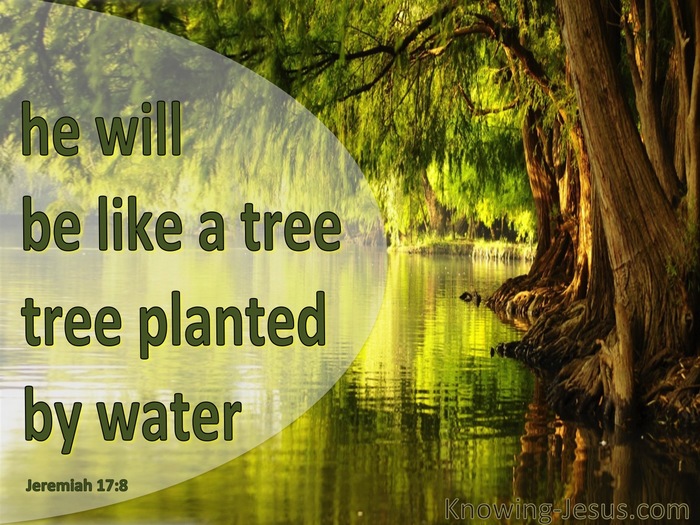
Psalm 1 likens the one who delights in the Lord to a well-watered streamside tree that is always producing good fruit.  Jeremiah takes this image of the healthy, vibrant tree from the Psalms and develops it further.  The person of faith, the Christian focused on Christ at all times, has that fruit-producing vibrancy about her.  
Curiously, whereas Jesus begins with the one who obeys his word and the Psalm begins the comparison with the one who delights in the Lord, Jeremiah reverses the order.  He begins by talking about the one whose trust is in mere mortals.  That one, the prophet says, is cursed.  Why?  Human beings fail us, and when they do, we have to look for someone else to believe in and rely upon.  Then that someone else fails us.  It’s a constant struggle to gain our grounding.  Jeremiah says it is like a desert shrub.  That’s the endgame for the life of a person who relies exclusively on other people.  Prickly.  Dry.  Gasping for water.  Always taking and never giving.  That’s the life of the person who refuses to trust solely in God.
But the one who trusts in God is blessed.  That person’s life, like the streamside tree with deep roots, is refreshed.  Even in the scorching heat of the pressures of life: bills piling up; betrayals by loved ones; losses; even in hard times, that person is refreshed by God.  As the tree’s leaves stay green, the one trusting God remains vibrant and strong, fully alive, fully engaged in life, and optimistic that life will turn for good because God intends good for us.  As the streamside tree continues to bear fruit, the one whose trust is in God produces good things in his or her life.  As Jesus says in Matthew 7:20, he or she is a disciple known for the good fruit he or she produces.  And we know that fruit is love, joy, peace, patience, kindness, generosity, faithfulness, gentleness, and self-control.  That’s what we see in the life of the one who trusts God.
We have to choose.  Jesus in the Sermon on the Mount says, Hear what I say and do it.  Psalm 1, delight in the law of the Lord.  Jeremiah 17, trust in the Lord over the influences of critics, cultural movements, and other human voices.  Trust God over all these.  Obey, delight, trust.
Begin by deciding to believe that the Bible promises are true.  Ask the Holy Spirit to help you trust God.  Then, pick out the places where you know you have trusted in human wisdom and neglected God.  This week, turn to the Sermon on the Mount, Jeremiah 17, and Psalm 1.  Pray these scriptures.  Pray that the Holy Spirit would free your spirit and enable you to fully trust in the Lord with all the things of your life.
AMEN