Total Pageviews

Monday, February 12, 2018

“A Witness for our Day” (Daniel 6)


Sunday, February 11, 2018 
            I open with a question: “Decades from now, what will be written about the public testimony of the American Church in the early 21st century?”  This question requires some explanation.  Fifty years from now, when the writers of history look back at the years 2000-2020, what will they remember about the church in the United States?  In Chapel Hill, North Carolina? What will be said about the way the church in our day represented God and trusted in God?
            It’s an odd way to think about things.  Imagining people fifty years from now as they remember us: who does that?
            That is what we do when we read Daniel.  We remember how the chosen people of God, ancient Israel, lived out their faith while they were exiled in Babylon and then Persia, when that empire overran Babylon.  We learn about faith by seeing how Daniel stayed true to God even when Persian religious leaders tried to corrupt his faith.  We learn about dedication to God by seeing how Jews in Jerusalem in 164 BC were inspired by reading Daniel and thus stood up to the horrible persecution wrought by Antiochus Epiphanes IV.  
            In the days of Daniel, people of faith, Daniel and his friends, gave witness to the goodness and authority of God before powerful Pagan rulers. In the days of Antiochus Epiphanes, the Jerusalem Jews gave witness to their faith in God by rebelling against the tyrant who declared himself a god.
            In our day, what is our faith saying?  What is our exercise of faith saying about us and what are we saying about the Kingdom of God that, in Jesus, has invaded the present day and has confronted present day governments?   How does our faith speak?  

            Daniel chapters 1-6 are examples of “martyr stories.”  The Greek word ‘martyr’ actually means witness.  We have taken it to mean one who dies for their faith, but in fact, it means witness.  To follow Jesus is to be a witness, one who has seen and received the salvation Jesus gives.  All Christians are witnesses.  Is our witness strong enough that we would live up to the modern day definition of ‘martyr’ if that were called for?  One commentator describes Daniel as a man with “unflinching faith.”  When future generations talk about the way we represented Christ, will they look at us and say, ‘When they were challenged to deny Christ, they stayed true and did not flinch?’”

            By the time we are in Daniel 6, Daniel has survived several tyrant-rulers of Babylon.  In fact, he outlasted the Babylonian empire.  Daniel was among a group of young, talented Jews who were essentially kidnapped when Babylonian forces defeated the Southern kingdom of the Jewish people, Judah, and overthrew the capital, Jerusalem.  They brought the brightest and best of Judah’s young people back to Babylon to indoctrinate them in Babylonian court life. As the ultimate humiliation, they intend to take these young people, Israel’s future, and turn them into loyal Babylonians.  
            It didn’t work.  In spite of multiple death threats and execution attempts, Daniel and his friends Shadrach, Meshach, and Abednego, stayed true to God.  Now, in chapter 6, Babylon has been replaced by Media-Persia, ruled by Darius.  
As he did under the Babylonian monarch, Daniel thrived under Darius, distinguished himself, and rose in prominence.  He was so impressive, Darius planned to install Daniel as the primary administrator for the entire Persian Empire.  Of course this did not sit well with other administrators, called “satraps” (v.1, 2).  These Persians, Daniel’s political rivals, knew they had no chance of matching Daniel’s wisdom in governing.  However, they held two trump cards.  
First, they understood the connection between Persian law and Darius’s ego.  Under Persian law, no one, not even the king, can go against an established edict.  Once it is written and sealed, it must be observed.  The only way to overcome a hastily enacted law is to enact another that will override the first.  
We see this in the book of Esther.  The anti-Jewish schemer Haman convinces the king to write an edict that will effectively wipe out the Jews.  The feeble minded king allows himself to be manipulated into legalizing genocide.  Once Esther reveals the wicked plot, the only recourse the king has is to write another law that allows the Jews to arm and defend themselves.  Even though he is king, he is powerless to overturn an established law.
The satraps around Darius in Daniel chapter 6 know this.  And they know Darius’s ego will render him short-sighted.  So, they convince him to enact a 30-day law.  For 30 days, no one in the Persian Empire may pray to any god other than Darius himself.  Darius, in his heart of hearts, knows he cannot answer prayer.  He does not have that power.  He knows this.  
But, he think to himself, “This will be cool.  For 30 days, everyone will worship, only me. How awesome!” So he signs it into law.  This is where the satraps play their second trump card.  They know how loyal Daniel is to the God of Israel.  Darius knows it too, but he didn’t consider the consequences of his actions.  He was enamored with the idea of people bowing before him, but he didn’t stop to think of whom the law would affect and how it would affect them.  
The plan devised by the satraps goes perfectly.  As scheduled, Daniel goes to his open window in his upper room, faces Israel, and begins to pray.  They got him!  He’s praying to God, not to Darius.  They run over each other as they sprint to the king’s chamber to report that Daniel has violated the edict.  
And we see just how powerless this king is.  He’s passed a law requiring people to pray to him.  Not only can he not answer anyone’s prayers, he cannot even overturn the law to save the life of one he likes and trusts - Daniel.  He tries!  But the nefarious satraps say, “Know, O king, that it is law of the Medes and Persians that no interdict or ordinance that the king establishes can be changed” (6:15).  He to whom the Persians must pray is a slave to the law he himself established.  Daniel must face the prescribed punishment for violating the law.  He must be thrown into the lion’s den.  
It was an underground cave, with a stone over the opening in the top; a very inhumane existence for the lions.  But we know the ancients did this sort of thing.  Roman, Persians and other ancient peoples would keep what are meant to be wild, free-roaming beasts, lions and other big cats, in captivity.  They kept the beasts hungry, so when a gruesome execution was called for the predators would be eager to devour whatever fell through that hole.  
Because of Darius’s irresponsible edict, Daniel was what went through the opening.  As he was lowered to a certain death, Darius desperately cried out, “May your God whom you faithfully serve deliver you” (6:16).  And the hole was covered with the stone and the king’s wax seal was affixed so that the hole could only be opened at the king’s command.
Then, Darius spent the night violating his own law.  It says he did not eat or sleep all night long.  Everyone in the Persian Empire was mandated by law to pray to this guy. Praying to anyone else led to a date in the lion’s den.  And here is Darius praying to someone else - the God of Abraham, Isaac, and Jacob.  Verse 18 only says that he fasted, but he had just proclaimed, as Daniel was lowered in, that Daniel’s God could save him.  That kind of faith statement leads me to think he spent the night in prayer, asking God to save Daniel from his, Darius’s impulsive foolishness.
Darius was up at daybreak.  He had obeyed the law.  Now he would break the seal, open the hole, and see if his prayers were answered.  “Daniel,” he called, “has your God delivered you” (v20)?
“Daniel then said to the King, ‘O king, live forever!  My God sent his angel and shut the lions’ mouths so they would not hurt me, because I was found blameless.  ... I have not done no wrong” (v.21-22).   God, unlike Darius, is not subject to any law.  Daniel technically did violate the king’s edict by praying to God.  
Sometimes that’s the call of faith.   Church goers get uncomfortable when politics shows up in sermons, but if we seriously engage the stories of the Bible, it is impossible to avoid politics.  In Acts chapter 6, the early church appointed seven of those early Christians to be the first deacons, charged with church administration.  One of them, Stephen, was also a preacher.  
He was working miracles of healing and exorcism, and he taught that Jesus fulfilled the Law of Moses.  Enraged synagogue leaders rallied the temple high council of scribes and elders and a gang enacted a people’s arrest.  They dragged Stephen before the council who interrogated him about his preaching.  The entirety of Acts 7 is Stephen’s sermon.  The basic content is a recounting of the Old Testament story that leads to a climax of accusation.  Stephen accuses the temple leaders of executing God’s prophet, but not only a prophet; the Holy One of God, the Son of Man, Jesus.
For Stephen, to stay true to God, meant to openly oppose those who possessed political power - the temple leaders.  To preach the gospel meant to participate in subversive politics.  The same was true for Daniel 500 years earlier and for the Jews under Antiochus 200 years earlier.  
The temple leaders stoned Stephen to death. When we are faithful in the face of oppression and challenge, there is not a guarantee that God will spare our lives.  Sometimes our witness brings suffering.  Look at Stephen who died a horrible death by stoning.  Look at Christians today in North Korean and Iranian prisons.  Why was Daniel miraculously spared?  Why was Stephen and many other executed?  Why are our brothers and sisters in the faith in other countries today persecuted and imprisoned?  Much of the time, only God knows the answer to the “why” questions.

Not always knowing the “why,” we can answer the “what?”  What will future generations remember about how we represented Jesus and spoke the Gospel truth to our generation?
I pray they will remember that we were clear: God and only God is all-powerful.
I pray that they will remember we shared hope: in Jesus Christ, there is life.  All are sinners, but he offers forgiveness and in him, we have a right relationship with God in spite of our sins.  Jesus makes us new, adopted as sons and daughters of God.
I pray they will remember that our faith was fearless, unflinching: we did not put our trust in a political party; we did not give our loyalty to a government or a nation.  We lived as God’s possessions, as disciples of Jesus Christ.  
I pray that they will remember what we said about Jesus and that we demonstrated the love and grace of God, and in remembering our witness, future generations will become Christ followers.

It is a choice.  Faith wasn’t a part of Daniel’s life.  Faith was his life.  Everything in life, for Daniel, happened in light of his relationship with God.  We can choose to have church, faith, prayer be a small part of our lives.  I am not sure what to call those who make that choice.  If we choose a Biblical faith, the faith embodied by Daniel and Stephen and many others, it becomes our everything.  Faith is not a part of our lives.  Faith in the living God is our life and we cannot imagine life without it.   We would rather lose, suffer, and die than abandon faith.
Lent begins this Wednesday, Ash Wednesday.  For our church it will be a time to focus on repentance (turning to God) and unity (our interconnectedness in Christ).  It will also be a time of spiritual discipline.  
I will talk a little bit about this in the Ash Wednesday worship service and in next week’s sermon. I urge you to take up spiritual practices that help you grow in your relationship with Christ.  The reason Daniel was ready to face lions is his spiritual life was forged in daily discipline.  He prayed three time a day, without fail.  He recognized God because he was attuned to God through daily practices.  
God is always with us, in our successes and when we suffer.  We are more ready to see and hear God, and to respond in faith, as we condition ourselves to listen.  As we move into the week ahead, I encourage everyone to be ready to take up spiritual disciplines and to grow in the relationship with God.  You might not have a lions’ den ahead of you, but there will be trials.  God is bigger than the trials and will be there to help you.  So, I encourage you seek him and to speak his Gospel whenever the opportunity arises.
AMEN

Monday, February 5, 2018

Daniel 5


            Who or what holds influence over you?  Answering this takes a commitment to self-examination.  You have to acknowledge that you allow yourself to be swayed by someone.  A TV personality?  A best friend?  Your husband?   Your mother?  A boss?  Whose voice is always speaking in your head?
            Think about these questions.  As we enter the story of Daniel, examine your life.  In your mind’s eye see that person or group or organization that holds sway with how you think and act.  It could be a good influence or maybe one that’s not so positive.  For now, just think about.  Be honest with yourself.  Who influences you?
We’ve journeyed through the first 4 chapters of the book of Daniel with Daniel and his three friends, young, pious Jews in exile in Babylon during the late 6th century BC.  Now we turn the page to chapter 5.  Daniel has spent most of his life in Babylon.  Because of his great successes interpreting dreams for the lunatic monarch Nebuchadnezzar, he has risen to the top of the Babylonian government even though he’s a slave. 
            But now, Daniel is an old man.  Nebuchadnezzar has been replaced by an even crazier ruler, Belshazzar.  This younger Babylonian doesn’t really know Daniel, so Daniel has been shuffled off, some out-of-the-way place, forgotten.  Belshazzar has no time for Jewish wise men.  He’s basking in the glory of being the top man in Babylon.
            We read that he holds a great festival for a 1000 of his noblemen.  These were Babylon’s elite, the richest of the rich.  Belshazzar is the most powerful of them all, a great man displaying his own greatness before an assembly of the upper crust of society. And they were drinking.  A lot.
            Verse 2 says, “Under the influence of the wine” – stop right there.  I’ll take the occasional social drink, a beer here, a glass of wine there.  Jesus did it.  Consumption of alcohol has been a part of human life going back to the days of Noah.  And, going back to the days of Noah, bad things happen when a story begins “under the influence of the wine … .” 
That’s Daniel 5:2.  Verse 1 told us Nebuchadnezzar is off the stage, Belshazzar in his place.  In that role, much as Nebuchadnezzar did, Belshazzar feels he has to extravagantly display his opulence and splendor.  It’s not just a party.  It’s a party of nobles – 1000 of them.  And they all watch in wonder as Belshazzar drinks himself stupid.  Nothing good happens after the point in the story that says, “Under the influence of the wine.”
The wine brings out the worst in him.  What brings out the worst in you?  Fatigue?  Drinking?  Pressure at work?  Certain friends or relationships?  What is that thing that when it comes up in your life leads to you being your very worst self?  Belshazzar drank to the point that the alcohol, not his own mind, was in control.
Then, he commands the vessels of gold and silver that were taken from the temple in Jerusalem to be brought out.  Before it was demolished by conquering Babylonian soldiers, the temple was the center of Israelite worship. Solomon and the priests who served during his reign tried to replicate the practice Moses established for worship at the Tabernacle in the wilderness.  It’s described in Exodus.  Solomon moved that Tabernacle worship indoors, into the temple his workers built.  This is found in the first 11 chapters of 1 Kings.  The golden cups and bowls from the temple were sacred for Israelite worshipers.  These items were taken as the spoils of war before the temple was destroyed.
Now in Daniel 5, Belshazzar in a blatant overture designed to magnify the Jews’ humiliation, parades these sacred cups and bowls out in front of the 1000 nobles who watch him drink.  He’s under the influence of wine.  He’s also under the influence of power. At his command, these items, sacred to the Jews, will be brought out.  Belshazzar is drunk on his sense of his own superiority. 
The Bible is full of characters like him: Goliath; Solomon’s son King Rehoboam; Nebuchadnezzar; in the days of Jesus both King Herod and Pontius Pilate.  Whenever we encounter one of these characters so self-obsessed it reminds us of the importance of humility.  In our relationships with each other and in the way we stand before God, we are called to act humbly and to live in gratitude and generosity.
Under the influence of wine and under the influence of power, Belshazzar tells the servants to fill up the golden temple vessels.  Fill them with wine.  Belshazzar is the under the influence of his sense of Babylonian glory.  He and his wives and his nobles and even his concubines all drink wine from those sacred cups there were used in the worship of Yahweh, the God of Abraham.  These Babylonians see the gold and assume it is theirs, up to their standard.
Finally, Belshazzar shows how much he is under the influence of the times – the day in which he lived.  He would have assumed that the God of Israel was in fact a real god.  There were not really atheists in antiquity.  He simply believed that the Israelite god was defeated soundly and permanently by the Babylonian god.  After drinking wine from the temple vessels, Belshazzar and all in his retinue break into spontaneous praise and worship.  They bow before the Babylonian gods.
See how this is depicted in Daniel 5:4.  “They drank the wine and praised gods of gold and silver, bronze, iron, wood, and stone.”  This formula is repeated throughout the Bible – the Psalms, Isaiah, Revelation.  The religion of Israel critiques other religions for worshipping statues.  Imagine that your god is a 100-foot tall statue of pure gold.  It’s an impressive statue.  Who could imagine the worth of such a thing in dollars?
However, it took workers who know how to melt and shape gold in order to make that statue look as it does.  It was created by people working very hard.  Once they were done, that statue just stands there.  It can’t do anything.  Biblical writers mock those who bow in worship before a statue who can’t walk or talk or think.  The gold idol is beautiful.  In terms of dollars, it is very valuable.  But it is a dumb piece of metal.  That’s it.  And there is Belshazzar under the influence of a dumb, albeit beautiful, chunk of metal.  That’s idolatry: giving adoration, loyalty, and worship to something that cannot give you anything in return.  That system of worship influenced this leader of Babylon – the mighty empire that ruled much of the ancient near east for over a century. 
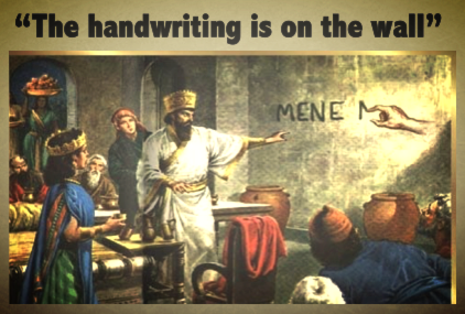
So he worships his idols while drinking in front of 1000 nobles and suddenly and hand appears; no body, just a hand.  The hand begins writing on the wall.  The 1000 nobles and the king freak out.  The wise men of Babylon are utterly incapable of understanding the deeper meaning of the words written on the wall.  Panic sets in on what had been a great party. 
Then the queen mother, one of the women who went through all of Nebuchadnezzar’s episodes with Daniel and the God of Israel, swoops to save the day.  She tells Belshazzar not to panic.  And she reminds him that Daniel is still around and can probably interpret the signs.  So, he who was forgotten is summoned to once again explain to the pagans what God is saying.
Wine, power, prestige, and idolatry: you know what does not influence Belshazzar in this story?  Worship of the true God, the God of Israel, the God of Abraham, Isaac, and Jacob; the one and only God was ignore by this pompous fool.  When young Daniel confronted King Nebuchadnezzar, he had compassion for the king.  He was concerned about the king’s ignorance.  He would warn Nebuchadnezzar, and the king, after being confronted by Daniel and by God, would turn around.  He would give God the praise God is due.  We see this in each of the first four chapters.
Now knowing Babylon will fall, old Daniel only has condemnation for Belshazzar the bumbling blowhard.  Daniel comes in as summoned, but he has no encouragement for the king.  Instead, he recounts the madness Nebuchadnezzar suffered when he strutted in the same pride Belshazzar displays.  Daniel retells this story because Belshazzar should have known.  He should have learned from Nebuchadnezzar’s errors, but he doesn’t. 
So, Daniel says to him, “You, Belshazzar, have not humbled your heart, even though you knew.  You have exalted yourself against the Lord of heaven!”  Daniel names his crimes: exploitation of the vessels of the temple, and the practice of idolatry.  Then Daniel says, “The God in whose power is your very breath, and to whom belong all your ways, you have not honored” (5:23).   Then Daniel interprets the handwriting on the wall. 
“God has numbered the days of your kingdom and brought it to an end; … you have been weighed on the scales and found wanting; … your kingdom is divided and given to the Medes and the Persians” (5:26-28).  Belshazzar did not have the encounters with God Nebuchadnezzar had, but he knew the stories.  He was only responsible for what he knew.  He ignored what he knew.
We don’t have the same encounter with Jesus the disciples had.  They walked the highways and byways of ancient Israel with him.  They sailed the Sea of Galilee with him.  We have their stories and the church and the Holy Spirit.  We are responsible for what we know.  Last week, this was the main point in our look at Daniel chapter 4.  The way we experience life is directly related to how we respond to what we know to be true about God.  
To this we add the opening question I asked: what or who influences us the most? 
The Apostle Paul says in Philippians 2:5, “Let the same mind be in you that was in Christ Jesus.”  And in Colossians 3:2, “Set your minds on things above, not on things that are on earth (like statues or gold or status or popularity or wealth), for we have died, and our lives are hidden with Christ in God.  … Put to death therefore whatever is earthly: fornication, impurity, passion, evil desire, and greed” (v.2-4, 6). 
Belshazzar wanted 1000 nobles to see how great he was.  He let power and drunkenness define him.  Daniel was so loyal to God and so confident in God, he defied Belshazzar and condemned him and the 1000 nobles lying prostrate before a statue. 
What happens in our lives if we put to death earthly things?  How are our lives different if we quit trying to impress the people around us?  What if we stop caring about what they think and fix our eyes upon God? 
At times, Daniel surely felt lonely.  It’s hard to tell the truth when you feel like you’re the only one who knows it.  But God gave him the courage he needed and God does the same for us when we keep our minds him.  Read the Bible consistently, over and over.  Pray every day.  Worship God without missing, without allowing other things to take priority in life.  Give yourself to relationships within the church, the Christian community.  These are all ways of helping the relationship with God grow deeper and as we mature in faith, we hear God more clearly. As we hear God, our courage to stand and speak God’s truth increases.  We might not ever be prophets who stare down drunken kings, but we are witnesses who testify honestly and convincingly.  We tell the good news of Jesus Christ to the world around us, a world that’s dying in sin.
That’s the true state of things.  The world in which we find ourselves, a college town in 21st century America, is as ignorant of God as was the court of the pagan Babylonian king in 500BC.  Daniel’s words did not change Babylon.  But, he made sure truth was spoken there.  We do the same when, with our choices, with our decision to love and not hate, and with our words we point people to Jesus.  We tell the truth.  We live under God’s influence and are not distracted or swayed. 
We are God’s possession destined for His kingdom.  We will live our lives with our eyes on Him. 

AMEN

Tuesday, January 30, 2018

And the Kings of the World will enter the City


I imagine a great parade, a procession full of color, music, pageantry, and the greatest of human glory.  Picture the “parade of nations” at the opening of the summer Olympics.  Now envision it on scale 100 times larger.
            “And I saw the holy city, the New Jerusalem, coming down out of heaven like a bride beautifully dressed for her husband.  … And the kings of the world will enter the city in all their glory.  And all the nations will bring their glory and honor into the city” (Revelation 21:2, 24b, 26).
            When reading a passages like this one, does it make you pause?  Similar ideas are found in the Psalms and Isaiah.  The great potentates of the world, the emperors and czars and presidents, will come as those paying tribute to one much greater than themselves: God.  Do you ever stop and try to picture it? 
            What is the expression on the face of Prime Minister Benjamin Netanyahu as he leads his retinue right alongside Iranian President Hassan Rouhani and his entourage? 
Where in this procession of the “kings of the world” is the “king” of the United States?  How close in the line is he to the “king” of North Korea?  Each in their own way has had demigod status attributed to him.  What is the level of confidence and bluster as they walk into the presence of the actual God?

Recently the United State President Donald Trump met with President Paul Kagame of Rwanda.  In their public dialogue, both expressed appreciation for the other.  President Kagame said ”It’s always a great honor to meet the President of the United States, President Donald Trump. And we had good discussions of those two levels –the bilateral relations between Rwanda and the United States. Rwanda has benefitted tremendously from the support of the United State. In many areas where there is (inaudible) support operations we have carried out in different parts of the world, we had the United States, on our side, supporting us.” 
Just a week prior to this meeting, in a session with members of congress, President Trump expressed frustration at the number of immigrants coming to America from poor, Southern hemisphere countries.  Some in the meeting report that he is used an expletive to categorize these nations, mostly populated by dark-skinned people as he juxtaposed them to the more fair-skinned Norwegians as he pined for more of the Norsemen to come to America. 
The whole exchange was fraught with racial overtones and elitism and was one more opportunity for the president’s political rivals to pounce. 

What if we held in our minds these presidents (N. Korea, Iran & Israel, Rwanda & the United States,   pick your country  ) as we read Revelation 21?  What if we held Revelation 21:24 and the procession of kings in mind as we read news stories?  Does the word of God help us remember that presidents and kings and dictators are mere men and women, flawed human beings? In the light of the Kingdom of God, standing beneath the glow of the New Jerusalem, the United States is an impoverished, backward, place. 

However one may feel about our president, followers of Jesus are to pray for him and extend him grace.  This was true from 2000-2008, from 2008-2016, and it is true now. It always has been.  We who are in Christ don’t need to overreact every time the president say something stupid.  We see the glow of the city on the hill.  We’re walking toward it.  

Monday, January 29, 2018

Daniel 4 - Nebuchadnezzar's Madness


            Dream interpretation.  Giant statues of gold, silver, bronze, & iron. The fiery furnace.  The lions’ den.  Can you think of short stories anywhere as captivating as those in Daniel chapters 1-6?  On websites, on TV, on Twitter and Facebook, there’s so much noise.  There’s partisan division; a lot of shouting without much listening. 
            I wanted us to begin 2018 looking at stories in the Bible.  Stories hold our interest.  If the story is good, we listen, we absorb it.  We don’t need to talk or argue.  We can receive what the storyteller has to share.  If that good story is in the Bible, then we meet God in it.  And my hope is that we can focus less on the noise of angry politics and more on the God we meet in the stories of the Bible – the only true God. 
It doesn’t mean we ignore the world around.  God has something to say and God often speaks through His church who is meeting Him in the Bible and in worship and then speaking from that encounter. Current events are always on the table, but we speak to our day from God’s perspective and a primary source for God’s perspective is the Bible. 
We could have gone to the Gospels or great stories of David or some of the fascinating accounts in the book of Numbers or Judges, but, felt God leading us to Daniel.  Here’s a curious question.  Who was the first worshiping body to hear Daniel as Holy Scripture, stories of God, read in its worship gathering?  How did congregations before ours receive the word of God as we have it in Daniel?
The first group was the gathering of Jews in Jerusalem in the 2nd century, the 170’s – 150’s BC.  Israel was land God promised to the descendants of Abraham, the Jewish people, but they had not governed that land for a long time.  They were subjugated by the Assyrians in the 8th century, and then the Babylonians in the late 7th and early 6th.  Power passed to the Persians, and then the Greeks under Alexander the great.  It became really bad for the Jews in the second century as Alexander’s empire was divided among his four generals and Israel fell under the cruel hand of Antiochus Epiphanes IV.
He set up a statue right in the second temple, the temple of Haggai and Ezra.  In that space, holy to Jews, dedicated to God, he put up idols and performed abominable acts.  He persecuted and even killed Jews who would not renounce the way of Abraham and Moses.  The persecution under Antiochus was as bad as any the Jews had known.  In that context of humiliating oppression, Daniel was read as Holy Scripture for the first time.
Feeling powerless, worshipers could look to this Jewish hero who defied the might of Babylon and then Media and Persia.  While an exile, with no voice, Daniel and his friends stayed faithful in their worship of God and their refusal to participate in Pagan worship practices. 
In Daniel 1, they refused unclean food and ate only vegetables.  Maintaining proper dietary restraint as their tradition dictated, Daniel and his three friends outperformed all other Jewish conscripts and rose in wisdom and prominence before the Babylonian king.  In chapter 2, when death was the penalty for failure, Daniel successfully recited the king’s dream.  Daniel was praised even though he prophesied the king’s downfall. 
In chapter 3, Shadrach, Meshach, and Abednego refused to worship a statue of the king.  For such a brazen revolt against the king’s edict, the three young Jews were thrown into the furnace, and in an enraged act of overdoing it, the king demanded the heat be raised and it was to the point that some of the guards were consumed by flames; but not Shadrach, Meshach, and Abednego.  Accompanied by an angel, they strolled around unharmed. 
Chapter 3 ended with the self-aggrandizing King, Nebuchadnezzar, declaring that anyone who blasphemed against the God of Israel would be ripped limb from limb.  Ironically, he couldn’t see that his own edict violated itself.  God didn’t need to make such macabre threats and God did not generally rip people limb from limb.  God allowed those who turned against him to fall into the destruction that came as a result of their own bad choices.  He needed no help from Nebuchadnezzar.
Chapter 4, this week’s Daniel story, continues the madness of King Nebuchadnezzar.  It is true that absolute power corrupts absolutely, and in Nebuchadnezzar’s case, absolute power also scrambled his own brain and completely distorted his perspective.
Essentially what happens is the king has another dream.  This time when his own palace wise men and wizards cannot interpret it for him, he does not kill them.  Instead he moves on to Daniel.  Why he didn’t start with Daniel is anyone’s guess considering Daniel’s previous dream interpretation abilities.  In the dream, the king sees a tree – the great tree of the world.  All the world was blessed under the great tree.
However, a holy watcher (v.13) descending from Heaven declared the great tree should be cut down leaving only the stump.  The great tree will be but a stump, unprotected against the elements for seven years.  The voice of the holy watcher declared this would happen so that all the world would see that God most High is sovereign over even the great kingdoms of the world (v.17).  Those who rule kingdoms are no better than the poorest peasants and anyone who has power, has it because God has allowed them to have it. 
Daniel knew this dream was about King Nebuchadnezzar.  He didn’t want to tell the meaning because he knew it was bad news for the king.  However, Nebuchadnezzar encouraged Daniel, so he told him.  “The tree that you saw – it is you, O King” (v.20, 21).  Daniel went on to explain that Nebuchadnezzar had become the greatest king on earth, but by decree of God (v.24), he would be reduced to madness.  Nebuchadnezzar would leave human society and roam the wild fields, sleeping out in the open like an animal.  He would grow his hair and nails long and unkempt.  He would graze on grass like cattle.  He would lose the power of speech and logical thought.  This insanity would last seven years.  That’s how long it would take for King Nebuchadnezzar to see that God and not he was the all-powerful one. 
We aren’t told how the king reacted to Daniel’s interpretation.  The next word from the story teller is that all happened just as Daniel said it would.  Striding in all his royal finery along the roof of the royal palace, the king heard a voice from heaven declare all that had been said in the dream.  He was immediately driven from human society, stripped of his vestments and robes.  He became an inhuman creature, a mindless beast, and he stayed that way for seven years. 
Please note the progression of the story in Daniel 4.  It begins with King Nebuchadnezzar openly praising God.  “The signs and wonders that the Most High God has worked for me I am pleased to recount.  How great are his signs, how mighty his wonders!  His kingdom is an everlasting kingdom, and his sovereignty is from generation to generation” (4:2-3).  It is self-centered.  Look at what God’s done for me.  But it is praise directed toward God.  Then in the middle of the story, Nebuchadnezzar sings a different tune.  Verse 30, “Is this not magnificent Babylon, which I have built as a royal capital by my mighty power and for my glorious majesty?” 
What a pivot!  The king moves from praising God for his wonders to praising himself for his own might and power.  The story ends with the king once again praising God.  “Now I, Nebuchadnezzar, praise and extol and honor the King of heaven, for all his works are truth and his ways are justice; his able to bring low those who walk in pride” (4:37).  It’s a true statement and of all people, King Nebuchadnezzar would know.
What moves the story from self-serving praise to an unabashedly arrogant boast to humble praise?  There comes an interruption – and we all have these interruptions in our lives.  We don’t know if King Nebuchadnezzar heard the interruption.  We aren’t told.  We know King Antiochus Epiphanes IV did not hear God’s warnings.  He relentlessly terrorized the Jerusalem Jews in the second century BC and is thus forever vilified by the symbolism in Daniel.  He ranks with the worst of villains, Antiochus Epiphanes IV right alongside Hitler and all the malevolent despots of history.  No one is worse. 
Setting aside Antiochus, the interruption we see in Daniel 4 should be an interruption in our lives.  What matters for us today is when God interrupts our stories, to remind us that He is God and we are not, do we listen?  See Daniel’s fearlessness in verse 27.  He says right to Nebuchadnezzar’s face, “Atone for your sins with righteousness, and your iniquities with mercy to the oppressed.”  Daniel was in Babylon.  Back in Israel, people were starving to death because their cities had been toppled and left as rubble, and their crops had been burned.  The people were oppressed because of the way Nebuchadnezzar’s soldiers acted.  Now Daniel tells him, it is time to atone. 
Have we benefited because others have suffered.  Do we drink coffee made from beans harvested by laborers who are paid slave wages?  Do we wear clothes made in sweatshops were workers don’t get paid enough and have no option of leaving?  “Atone … for your iniquities by showing mercy to the oppressed.”  That’s the message at the heart of Daniel 4.  Verse 27, to show that you know and honor and bow before God, show mercy to the oppressed. 
Daniel left the wicked king a way out.  He didn’t have to crawl about on all fours like an ox or cow.  He didn’t have to lose his mind.  That’s where self-obsession and power-obsession leads: mania.  Daniel, anointed by God, pointed to another path.  We, readers of the story have that path before us. 
“Lord, when was it that we saw you hungry and gave you food, or thirsty and gave you something to drink.  And when was it that we saw you a stranger and welcomed you, or naked and gave you clothing?  And when, O Lord, was it that we saw you sick or in prison and visited you?  And the [King of all kings] will answer, ‘truly I tell you whenever you did it to the least of these my children, you did it to me’” (Matthew 25:37-40).
Do we see the interruption, hear the warning, and take the path opened before us by the word of God?  King Nebuchadnezzar did not.  He ignored the prophet’s word because he thought he was the ultimate one, the one favored by God.  He disregarded the warning, boasted of his own greatness, and ended up insane.  After his boast, he discovered that Daniel, whom he said he trusted, was right.  The prophecy Daniel gave came true. 
The crazy, grazing king returned to sanity when he lifted his eyes to heaven.  He strutted around when he should have bowed in humble worship, and so God, brought him low.  When, having been brought low, he raised his eyes in humble worship, God allowed him to stand once again.  The way we experience life is directly related to how we respond to what we know to be true about God.  
We know God through our knowledge of God’s son, our Savior Jesus Christ.  Note the difference between Jesus and the evil king of Babylon.  Nebuchadnezzar was a man who thought he was on equal footing with God.  Jesus was God who had become a man. 
Philippians 2:5-11:
5 Let the same mind be in you that was[a] in Christ Jesus,
6 who, though he was in the form of God,
    did not regard equality with God
    as something to be exploited,
7 but emptied himself,
    taking the form of a slave,
    being born in human likeness.
And being found in human form,
8     he humbled himself
    and became obedient to the point of death—
    even death on a cross.
9 Therefore God also highly exalted him
    and gave him the name
    that is above every name,
10 so that at the name of Jesus
    every knee should bend,
    in heaven and on earth and under the earth,
11 and every tongue should confess
    that Jesus Christ is Lord,
    to the glory of God the Father.
           
            In life, when we are up against tremendous challenges, maybe under the heel of our own Nebuchadnezzar or Antiochus Epiphanes, we praise God because we know God is in control and will carry us through our hard times.  In life, when things are going well, and we find ourselves on top, doing the winning, we bow in humble worship and praise God, thanking Him for our successes as we work to be generous in uplifting those around us who wallow in their struggles.  When we’re up, when we’re down and at times in between, we praise God.
            Anne Lamott has write book titled Hallelujah Anyway!  The idea is that even when life is thoroughly crud-filled and painful, was praise because God is there.  Based on the idea that God is there and that we have the Daniel opportunity before us – to take the path of worship and mercy – I proposed a modification on her title.  God is God and we aren’t.  God is here and it is a good thing that God is here because God can and will help us. 
            Maybe on a hard day we say Hallelujah Anyway!  But, knowing God is with us, we say, Hallelujah Always.  God is in Babylon and God is here, and in control.  That’s good news, the very best of news. 


AMEN 

Tuesday, January 16, 2018

Book Review: Faithful Presence (David E. Fitch)


David Fitch presents seven disciplines for the church; disciplines that, when lived out, synthesize the organized Missio Dei approach to mission first described by Newbigin and an incarnational approach to ministry.  Fitch believes he has a finger on the pulse of what it is for the church to be a faithful witness to the Kingdom of God in the world.  I think he is right.
            The disciplines he proposes are, the Lord ’s Table, reconciliation, proclaiming the Gospel, being with the ‘least of these,’ being with children, fivefold gifting, and Kingdom prayer.  In addition to these disciplines, he talks about four postures, submission, receiving, ceasing, and socially engaging.  His most compelling words are his description of mutual submission.

            I wonder what the world would look like if more churches committed to the disciplines Fitch proposes and lived in the postures he describes.  I think I know.  I am sure I know what Fitch would say.  We would see the in-breaking of the Kingdom.  What a sight that would be … will be.

The Lord of History (Daniel 2)


Who has the power? 
I recently read the highly acclaimed novel Purple Hibiscus.  In it, Kambili, a teenaged girl in a wealthy Nigerian family knows that all the power is in the hands of her father, Eugene Achike.  The novel is the story of this quiet, insightful girl discovering her own soul as she navigates the scary world of her oppressive dad’s abuse and benevolence.  He can be either, abusive or benevolent, because he has all the power. 
Look around your life.  At work; at home; out and about, around town; at extended family gatherings; in dealing with public officials; who holds the power in your life?  Are those who hold power heavy handed?  Do you feel pushed?  Do you have the power to push back?  Are the powerful generous?  Do they empower you, or keep you down?  If they keep you down, is there anything you can do? 
What is our understanding of power? 

In the book of Daniel, we find young Jews, forced into exile in Babylon.  They are subject to the whims of the mighty Babylonian king.  Remember, this story happens away from the land of Israel.  The Babylonians, intended to transform these Jewish they had taken into the way of Babylonian nobility.  Among the exiles were four friends, Daniel, Hananiah, Mishael, and Azariah.  These four were exceptional intellects and fiercely loyal to God.
As we enter the story, imagine the power holders in your life.  When you think ‘power,’ do you envision President Trump?  Does a bully from school who has lorded over you come to mind?  Do you think of your mom or dad, or an authoritative grandparent, someone to whom your entire family defers?  As we step into Daniel keep in your mind, your own sense of who holds the power.   

            It begins,
2 1-3 In the second year of his reign, King Nebuchadnezzar started having dreams that disturbed him deeply. He called in all the Babylonian magicians, enchanters, sorcerers, and fortunetellers to interpret his dreams for him. When they lined up before the king, he said, “I had a dream that I can’t get out of my mind. I can’t sleep until I know what it means.”
4 The fortunetellers, speaking in the Aramaic language, said, “Long live the king! Tell us the dream and we will interpret it.”
5-6 The king answered the fortunetellers, “This is my decree: If you can’t tell me both the dream itself and its interpretation, I’ll have you ripped to pieces, limb from limb, and your homes torn down. But if you tell me both the dream and its interpretation, I’ll lavish you with gifts and honors. So go to it: Tell me the dream and its interpretation.”
7 They answered, “If it please your majesty, tell us the dream. We’ll give the interpretation.”
8-9 But the king said, “You’re wasting time. You know that if you can’t tell me my dream, you’re doomed. I see right through you—you’re going to make up stories and confuse the issue until I change my mind. Nothing doing! First tell me the dream, then I’ll know that you’re legit with your interpretation.”
10-11 The fortunetellers said, “Nobody anywhere can do what you ask. And no king, great or small, has ever demanded anything like this from any magician, enchanter, or fortuneteller. What you’re asking is impossible unless some god or goddess should reveal it—and they don’t hang around with people like us.”

            Now, note this!  The fortune tellers may be frauds when it comes to actual spiritual insight, total charlatans; snake-oil salesmen.  However, what they tell the king here is completely true.  There’s no way they could look into his head and know his dreams

12-13 Their frank admission of their own limitations set the king off. He lost his temper and ordered the whole company of Babylonian wise men killed. When the death warrant was issued, Daniel and his companions were included. They also were marked for execution.
14-15 When Arioch, chief of the royal guards, was making arrangements for the execution, Daniel wisely took him aside and quietly asked what was going on: “Why this all of a sudden?”
15-16 After Arioch filled in the background, Daniel went to the king and asked for a little time so that he could interpret the dream.
17-18 Daniel then went home and told his companions Hananiah, Mishael, and Azariah what was going on. He asked them to pray to the God of heaven for mercy in solving this mystery so that the four of them wouldn’t be killed along with the whole company of Babylonian wise men.

            Daniel’s first act was to pray and to invite the community of the faithful to join him in prayer.  When we come up against the power holders in our lives, how much time do we spend worrying and how much time do we spend praying?  You can do both.  We can pray while carrying burdensome worries. And we should.  But how much time do we spend just worrying without even give a bit of attention to the power held by the creator of the universe who, in the Holy Spirit, is with us all the time?  God is real, is present, loves us, wants to help, and is able to help?  Do we trust God or simply surrender to the powers around us that would control us for their purposes, not for our good?

19-23 That night the answer to the mystery was given to Daniel in a vision. Daniel blessed the God of heaven, saying,
“Blessed be the name of God,
    forever and ever.
He knows all, does all:
    He changes the seasons and guides history,
He raises up kings and also brings them down,
    he provides both intelligence and discernment,
He opens up the depths, tells secrets,
    sees in the dark—light spills out of him!
God of all my ancestors, all thanks! all praise!
    You made me wise and strong.
And now you’ve shown us what we asked for.
    You’ve solved the king’s mystery.”

            We need to know the King’s dream so Daniel can interpret it and avoid a violent, painful death.  But, the writers of Daniel don’t think that’s the most important thing.  Before telling us how Daniel avoids suffering and destruction, they tell us how Daniel praised God.  Praise of God is more important than easing the anxiety of a pagan king.
            Daniel said of God. “He knows all and does all.  He changes the seasons and guides history.”  Anything King Nebuchadnezzar has, he has because God allows it.  That king was evil and did evil things.  God did not cause him to do evil things.  There are evil power holders in the world today and when they say stupid, racist things and do evil things, they are not speaking and acting on God’s will.  But, they are only able to act on the evil in them because God allows it.  In God’s perfect timing, the powers in the world are toppled. 
            At the end of history, the overthrow of evil happens permanently and the Kingdom of God, which began coming in Christ, comes in fully.  Why has this not come to fulfillment yet?  I don’t know God’s timing.  But I believe in God’s wisdom.  In the Gospel of Matthew, chapter 13, Jesus tells a story of wheat growing alongside weeds.  The wheat is the fruit of the Kingdom of God and the weeds are the presence of evil in God’s good world.  Jesus says that for the time being, the evil and the Godly grow side-by-side, but at the last judgment, the wheat will be gathered into God’ “barn,” the New Heaven and New Earth joined in perfect harmony.  
            Until that time, the Lord of history, the true power in the world, our God, is with us in the form of Holy Spirit, guiding us as we live as His people, inviting the lost into his family.  That’s how Daniel navigated the paganism of King Nebuchadnezzar, as an enslaved exile.  He lived as God’s child in an evil environment by keeping his eyes on God, fully trusting in God’s presence and God’s power.

The story picks up in verse 24.
24 Daniel went back to Arioch, who had been put in charge of the execution. He said, “Call off the execution! Take me to the king and I’ll interpret his dream.”
25 Arioch didn’t lose a minute. He ran to the king, bringing Daniel with him, and said, “I’ve found a man from the exiles of Judah who can interpret the king’s dream!”
26 The king asked Daniel (renamed in Babylonian, Belteshazzar), “Are you sure you can do this—tell me the dream I had and interpret it for me?”

Note that at this point, Daniel essentially tells the king the same thing all his magicians and soothsayers said when they failed to know the king’s dream.

27-28 Daniel answered the king, “No mere human can solve the king’s mystery, I don’t care who it is—no wise man, enchanter, magician, diviner. But there is a God in heaven who solves mysteries, and he has solved this one. He is letting King Nebuchadnezzar in on what is going to happen in the days ahead. This is the dream you had when you were lying on your bed, the vision that filled your mind:
29-30 “While you were stretched out on your bed, O king, thoughts came to you regarding what is coming in the days ahead. The Revealer of Mysteries showed you what will happen. But the interpretation is given through me, not because I’m any smarter than anyone else in the country, but so that you will know what it means, so that you will understand what you dreamed.
31-36 “What you saw, O king, was a huge statue standing before you, striking in appearance. And terrifying. The head of the statue was pure gold, the chest and arms were silver, the belly and hips were bronze, the legs were iron, and the feet were an iron-ceramic mixture. While you were looking at this statue, a stone cut out of a mountain by an invisible hand hit the statue, smashing its iron-ceramic feet. Then the whole thing fell to pieces—iron, tile, bronze, silver, and gold, smashed to bits. It was like scraps of old newspapers in a vacant lot in a hot dry summer, blown every which way by the wind, scattered to oblivion. But the stone that hit the statue became a huge mountain, dominating the horizon. This was your dream.
36-40 “And now we’ll interpret it for the king. You, O king, are the most powerful king on earth. The God of heaven has given you everything: rule, power, strength, and glory. He has put you in charge of men and women, wild animals and birds, all over the world—you’re the head ruler, you are the head of gold. But your rule will be taken over by another kingdom, inferior to yours, and that one by a third, a bronze kingdom, but still ruling the whole land, and after that by a fourth kingdom, ironlike in strength. Just as iron smashes things to bits, breaking and pulverizing, it will bust up the previous kingdoms.
41-43 “But then the feet and toes that ended up as a mixture of ceramic and iron will deteriorate into a mongrel kingdom with some remains of iron in it. Just as the toes of the feet were part ceramic and part iron, it will end up a mixed bag of the breakable and unbreakable. That kingdom won’t bond, won’t hold together any more than iron and clay hold together.
44-45 “But throughout the history of these kingdoms, the God of heaven will be building a kingdom that will never be destroyed, nor will this kingdom ever fall under the domination of another. In the end it will crush the other kingdoms and finish them off and come through it all standing strong and eternal. It will be like the stone cut from the mountain by the invisible hand that crushed the iron, the bronze, the ceramic, the silver, and the gold.
“The great God has let the king know what will happen in the years to come. This is an accurate telling of the dream, and the interpretation is also accurate.”
46-47 When Daniel finished, King Nebuchadnezzar fell on his face in awe before Daniel. He ordered the offering of sacrifices and burning of incense in Daniel’s honor. He said to Daniel, “Your God is beyond question the God of all gods, the Master of all kings. And he solves all mysteries, I know, because you’ve solved this mystery.”
48-49 Then the king promoted Daniel to a high position in the kingdom, lavished him with gifts, and made him governor over the entire province of Babylon and the chief in charge of all the Babylonian wise men. At Daniel’s request the king appointed Shadrach, Meshach, and Abednego to administrative posts throughout Babylon, while Daniel governed from the royal headquarters.

            Living as a slave, forced to be in Babylon, Daniel rose to the top of the government.  He put all his trust in God as the overseer of all. 
Power has many faces in our time – the president; entertainment figures and business moguls.  In our town, powers appears to lie with the people who are bigwigs at the university or the leaders of the companies where we work.  In our social circles and in our own families, certain people seem to be the ones to whom everyone else defers. 
God is over all and God is with.  God may not elevate us to the top of government or the top of the company, but will elevate us.  God will comfort us, redeem us, and empower us.  As we are the voice of God’s compassion, insisting upon God’s truth, and speaking out in the face of oppressive powers, God walks with us, guiding us forward.  God will be faithful in meeting our needs as he was with Daniel.
“Truly, your God is a revealer of mysteries,” the king told Daniel. 
Daniel agreed saying of God, “He reveals deep and hidden things.” 
What will God the Revealer, reveal in our lives this week?  We find out as we look to Him in all things and in all places.  We don’t think as much about people around us, supposedly powerful people.  We don’t have the space.  Our brains and hearts are full of thought of God, love for God.  We turn to Him and He shows us the way.

AMEN